Biotech, The Next Set-Up

Charts by StockCharts

Note:  Posts on this site are for education purposes only.  They provide one firm’s insight on the markets.  Not investment advice.  See additional disclaimer here.

Print & Close

6:47 p.m., EST

Looking at inverse biotech LABD: Close basis.

Just a minute or two after LABD penetrated yesterday’s low, a huge block trade when by on the tape.

The trading platform used shows Level II, streaming Time & Sales with transactions color coded.

The color key is as follows:

Green, Buy

Red, Sell

Purple, Sell below bid

Yellow, Buy above ask

Grey, Transaction was (buy or sell) between the bid/ask

The large block was coded Yellow: Size 18,184 shares @ 24.2699

That equates to one trade with a value at $441,323.86 … essentially a half-million dollars.

What’s the point?

If there are too many stops at one area, trade execution is automatic. This type of behavior was detailed in a prior report, linked here.

It’s not unreasonable to think today’s action was for the purpose of allocating one trade at a half-mil. Novice traders and neophytes were used as the bait (setting their stops at yesterday’s low).

Setting the stops at that location would essentially make the computer algorithms go automatic to hit the stops (as described in the Martha Stokes’ link above).

Whoever made the block trade was willing to pay above ask so the entire transaction would be filled at once.

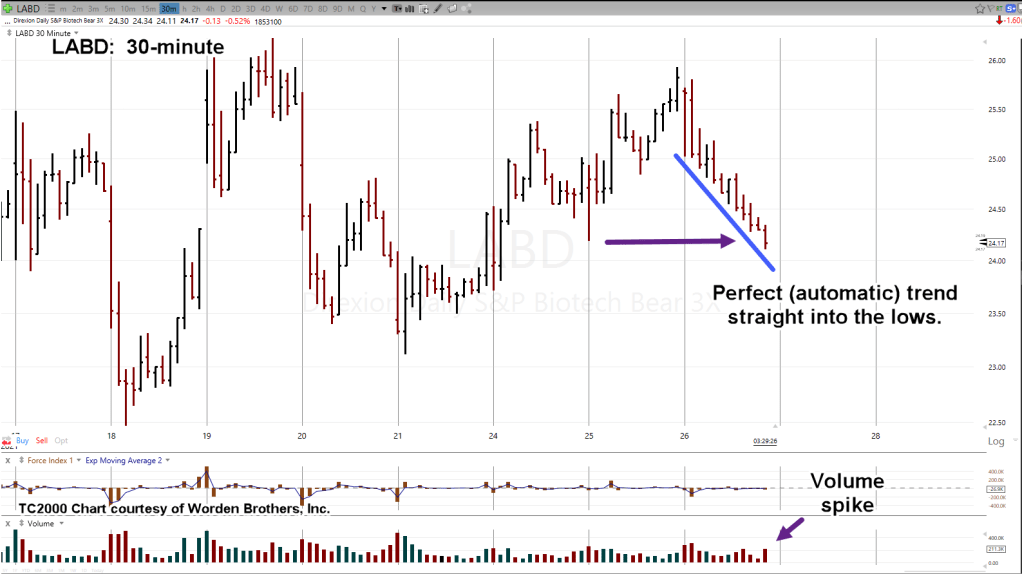
Looking at the 30-minute chart of LABD below, we see a near perfect descending line right into the lows of the prior session.

The first chart in this post has the actual close below support where the original forecast called it as a test.

The push below support on a print basis had occurred prior but the actual close below support (to complete the set-up) came two days later.

Here we are: Testing the spring set-up on a closing basis while potentially taking out the weak hands positioned long LABD.

It’s likely we’ll know tomorrow. If LABD price action opens higher and makes a new daily high, it’s a high reliability signal we’re under way.

If not, something else is at work … yet to be determined.

Stay Tuned

Charts by StockCharts

Note:  Posts on this site are for education purposes only.  They provide one firm’s insight on the markets.  Not investment advice.  See additional disclaimer here.

Run The Stops

It took the entire session on Friday for price action to hit the LABD stop @ 18.96.

It’s the way it happened, that defined what happened next.

Since we don’t have access to the order book, we can only conjecture where stop orders had accumulated.

The market’s interested in transactions, not levels. Wherever there’s a preponderance of orders … that’s where it goes.

Martha Stokes, CMT, put it well when she said (paraphrasing):

‘The Market Makers don’t know you are there; they’re not interested in your tiny little stop order.

If your order does get taken out, it’s because too many small traders put their stops at the same location.

There’s an order imbalance. The market’s response is essentially automatic … take out the stops.’

While the original LABD 18.96, stop may not have been a popular location for the small (and maybe big) traders, price action throughout the day could have ‘pumped’ the stops to that location.

Case in point is the huge block trade just at the 1:00 p.m. EST, mark.

At that point, 31,500 shares went by (on the tape) at price 19.10 … which equates to over $600,000 in one transaction.

So, where are you going to put your stop for that position. Below the market, right? Maybe at 18.95 let’s say? Especially so ,when price action instantly rallies away from that entry; all the way to 19.78, intra-session.

The stop would appear to be tight but well positioned.

However, if there was a stop for that huge block and it was too close to the market (with other stops accumulating), it would act as a magnet for price action; drawing it back to that level to get the transaction (hit the stop).

Of course, it’s all conjecture and we won’t ever know for sure.

If the LABD market opens significantly higher (IBB lower) on Monday, then our assessment looks correct.

A lower or unchanged open, signals us to get out. If that happens, then IBB is likely to be heading higher.

As you may have guessed by now, the response to all this kabuki was to re-position the stopped-out order.

The table below has the summary:

Note:  Posts on this site are for education purposes only.  They provide one firm’s insight on the markets.  Not investment advice.  See additional disclaimer here.