Note: Posts on this site are for education purposes only. They provide one firm’s insight on the markets. Not investment advice. See additional disclaimer here.
Note: Posts on this site are for education purposes only. They provide one firm’s insight on the markets. Not investment advice. See additional disclaimer here.
Note: Posts on this site are for education purposes only. They provide one firm’s insight on the markets. Not investment advice. See additional disclaimer here.
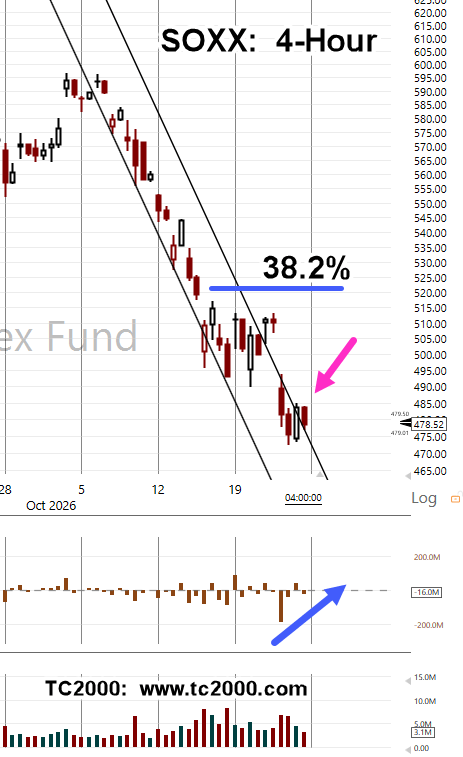
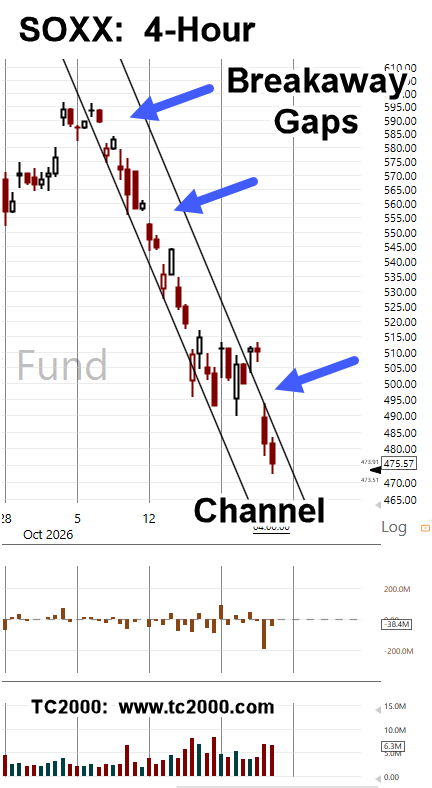
Today was supposed to be downside continuation if the trading channel was to remain in effect.
It didn’t happen
As the downside energy appeared to dissipate during the session, short trade SOXS-26-14, was closed with profit at +15.14% (not advice, not a recommendation).
The blue arrow shows Force Index losing steam to the downside.
The magenta arrow shows price action pushing through the trading channel.
Of course, more selling can come in late Sunday and into the Monday open.
However, at this juncture, a retrace to 38%, (and gap-fill) seems more probable (not advice, not a recommendation).
Note: Posts on this site are for education purposes only. They provide one firm’s insight on the markets. Not investment advice. See additional disclaimer here.
Note: Posts on this site are for education purposes only. They provide one firm’s insight on the markets. Not investment advice. See additional disclaimer here.
‘Surprises, tend to come in the direction of trend’.
The tenet, taken from Reminiscences of a Stock Operator, showing us the direction of trend for LRCX and the overall semiconductor index, is lower (not advice, not a recommendation).
In the after-hours, LRCX is down hard and the SOXX has taken a hit as well.
So, let’s look at what the SOXX is telling us.
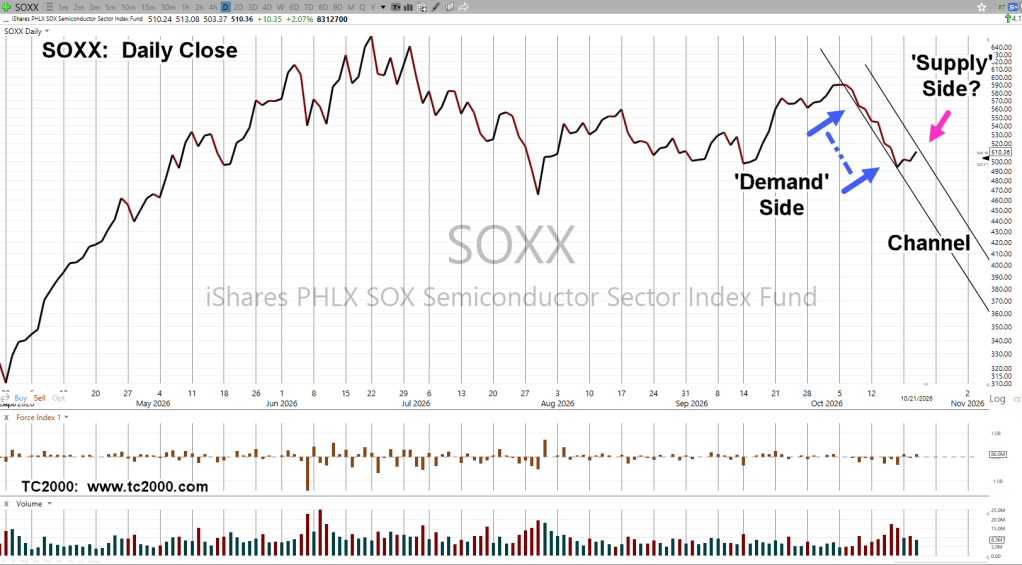
Semiconductor SOXX, Daily Close
For about ten trading days, the SOXX moved steadily lower along the ‘demand’ line shown.
Then, it paused for several days with sideways, corrective action.
Now, with the index likely to open lower, next session, the question is, are we at the ‘supply’ side?
Note: Posts on this site are for education purposes only. They provide one firm’s insight on the markets. Not investment advice. See additional disclaimer here.
Note: Posts on this site are for education purposes only. They provide one firm’s insight on the markets. Not investment advice. See additional disclaimer here.
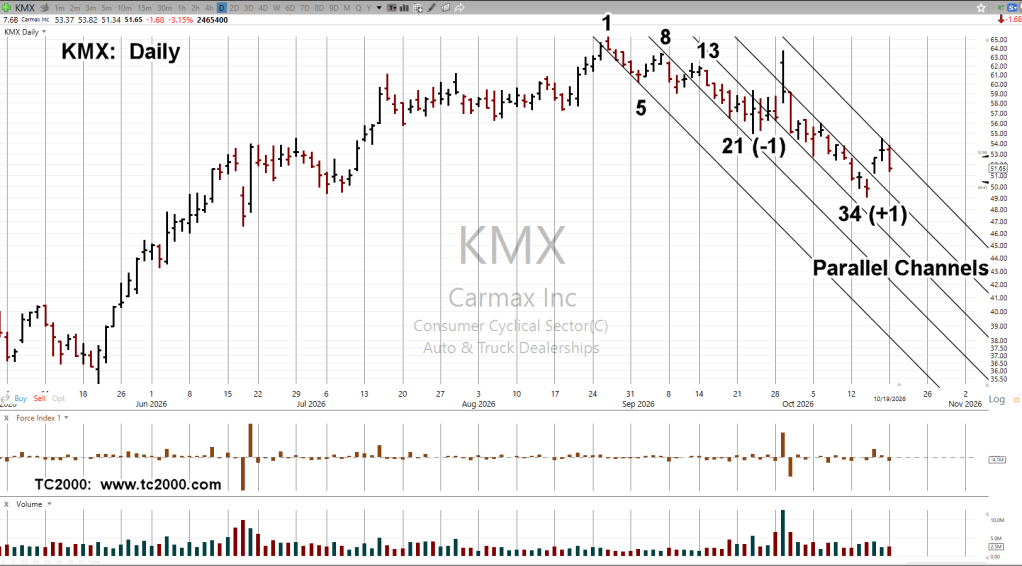
CarMax, is posting a series of parallel trading channels with inflection points identified (so far) by a Fibonacci count (not advice, not a recommendation).
Note: Posts on this site are for education purposes only. They provide one firm’s insight on the markets. Not investment advice. See additional disclaimer here.
Note: Posts on this site are for education purposes only. They provide one firm’s insight on the markets. Not investment advice. See additional disclaimer here.
Note: Posts on this site are for education purposes only. They provide one firm’s insight on the markets. Not investment advice. See additional disclaimer here.