Note: Posts on this site are for education purposes only. They provide one firm’s insight on the markets. Not investment advice. See additional disclaimer here.
The Good: Only the Senior Miners, GDX, have managed to claw their way past the highs set nearly five years ago in August of 2020.
The Bad: Junior Miners GDXJ, remain below that August ’20, level.
The Ugly: Silver Miners SILJ, are the worst, having their peak a bit later in February of 2021; they remain over -35%, below their highs.
The Market Rolls Over
Yesterday, Friday, was a down day for the Dow, S&P, The Qs, Transports, Airlines, Semis, nearly everyone.
For some of these indices, their all-time highs were posted months, if not years ago.
There may be some (bidding) ‘defensive’ action with gold (GLD) continuing higher; as said in earlier posts, the rest of the monetary metals are far below their highs.
Let’s look at the weakest; the silver miners, as they are likely going to be the ones most affected by an economic decline (not advice, not a recommendation).
Silver Miners, SILJ, Daily
We’re at an interesting spot.
Friday was a down day that pushed below existing support, shown in zoom area.
We have simultaneous action.
Once resistance was penetrated on March 18th, it could not hold. After eight trading days, on Friday, it posted lower on heavy volume.
However, we can see that SILJ, is now in (a minor) Wyckoff ‘spring’ position. So, the question is, what happens next?
Note: Posts on this site are for education purposes only. They provide one firm’s insight on the markets. Not investment advice. See additional disclaimer here.
While everyone else is focused on a ‘tradable bounce’ in the S&P, with others in a freak-out on gold, back at the ranch, biotech has continued to sub-divide lower, getting weaker and weaker, still.
Note: All trades presented on this site during 2024 (ex: UNG), and 2025, have been to the short side (not advice, not a recommendation).
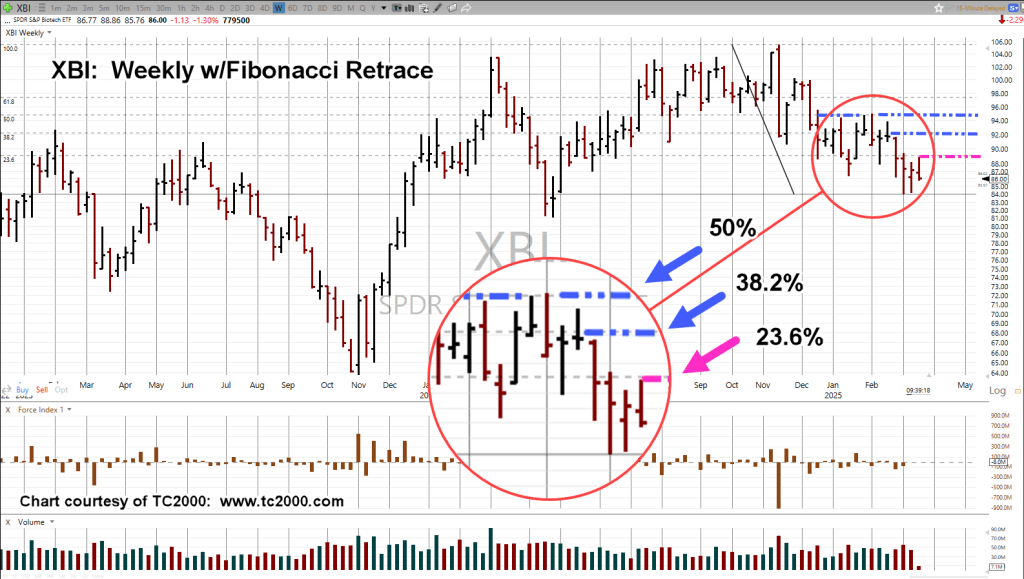
Biotech XBI, Weekly
The chart highlights the Fibonacci retrace levels.
A Fibonacci 23.6%, retrace is rare; markets typically like to go to 38.2%, or 50%.
If this retrace holds, it indicates significant weakness in the sector (not advice, not a recommendation).
As can been seen in the side-bar, current biotech short is LABD-25-03, with stop at yesterday’s LABD, session low (not advice, not a recommendation).
Not shown on the chart, a trading channel that appears to be in-effect.
Note: Posts on this site are for education purposes only. They provide one firm’s insight on the markets. Not investment advice. See additional disclaimer here.
One report covering the historic narrowing of the market is here.
Never before seen narrow breadth: What does it mean?
It means the market’s ‘keeping up appearances’ while the foundation’s been removed.
That way, the professionals can get out the door; sell or sell-short, funnel capital to the only three tickers left (AAPL, AMZN, MSFT), while the public looks at the SPY, and says ‘Where’s the collapse?’
Let the crowd focus on the S&P … probably the most computer controlled, AI driven, Machiavellian manipulated market in the world … but hey, I’ve got my i-phone trading app and I’m going to ‘Put it to the man’.
Meanwhile, downside leader biotech, inches lower.
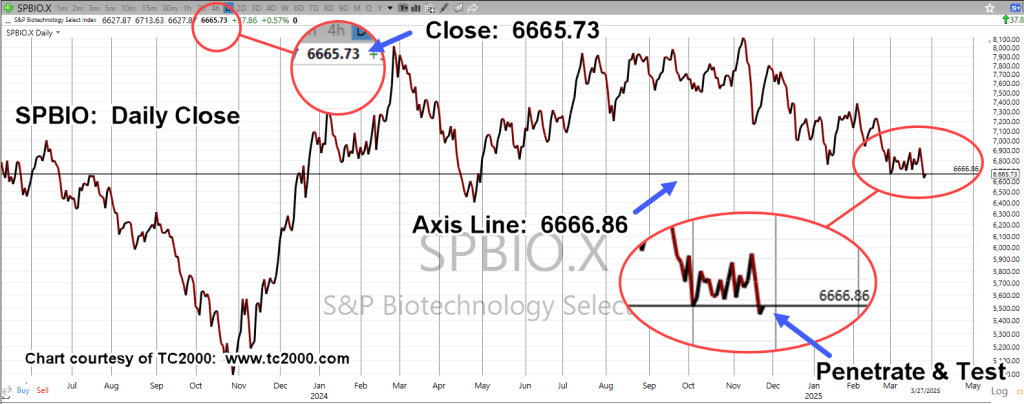
Biotech SPBIO, Daily
Let’s review where we are with SPBIO, with the full understanding that anything can happen.
For now, we’re heading lower (not advice, not a recommendation).
It’s obvious. Biotech’s following a Fibonacci time sequence.
Let’s pull out to the larger weekly chart and see something really scary.
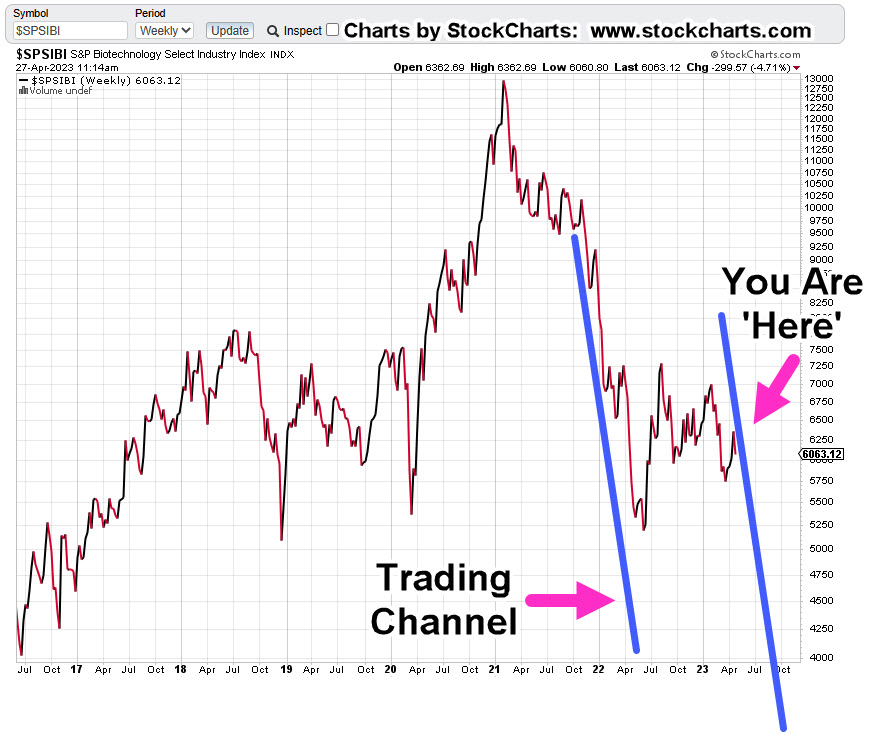
Biotech SPBIO, Weekly Close
If we really are at the right side of the trading channel, it’s not looking good for the bulls.
Of course, it all makes sense.
The market’s at record breadth divergence. Banks are collapsing, Ukraine (fabricated, or not) coupled with trade wars, the consumer’s tapped-out (credit at maximum) and on it goes.
Positioning
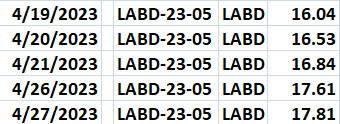
Early this session, the short position in biotech (via LABD) was increased (not advice, not a recommendation).
The table below shows the trading (entry) activity during the on-going reversal (not advice, not a recommendation).
Hard Stop: 16.79
The notation ‘LABD-23-05’, indicates this is the fifth trading campaign (or trade series) in LABD for the year.
Note: Posts on this site are for education purposes only. They provide one firm’s insight on the markets. Not investment advice. See additional disclaimer here.
Nemont Mining (NEM), Gold, and the Oil & Gas Sector are at a critical juncture.
The rest of the major indices, Dow, S&P, QQQs, real estate (IYR), and so on, are in a similar position.
For this update, we’ll focus on Newmont (NEM), as it’s the largest cap in the Senior Mining Sector GDX, and a general representative of the commodities markets.
Financial collapse is a process, not an event.
Newmont topped-out in April, of last year. Exxon, the proxy for the Oil & Gas sector, may have reached its highs this past November.
Where’s The Inflation?
As Michael Cowan has just reported, banks are absconding with depositor’s money under the guise of ‘bail-in’.
If the fiat cash is so worthless, why are banks seizing it?
As Robert Prechter Jr., said years ago, ‘all fiat cash ultimately goes to zero’; the end game (most likely) for the dollar. However, it could be months, years, or even a decade before that happens.
For right now, today, this minute, the data is showing us, the banks want the money; ‘Show me the money‘.
With that, let’s look at the non-existent ‘inflation’ in the mining sector.
Newmont Mining NEM, Weekly
The first chart identifies the heavy volume and then test of wide price bars. This behavior is common in the markets; they tend to come back and test wide high-volume areas.
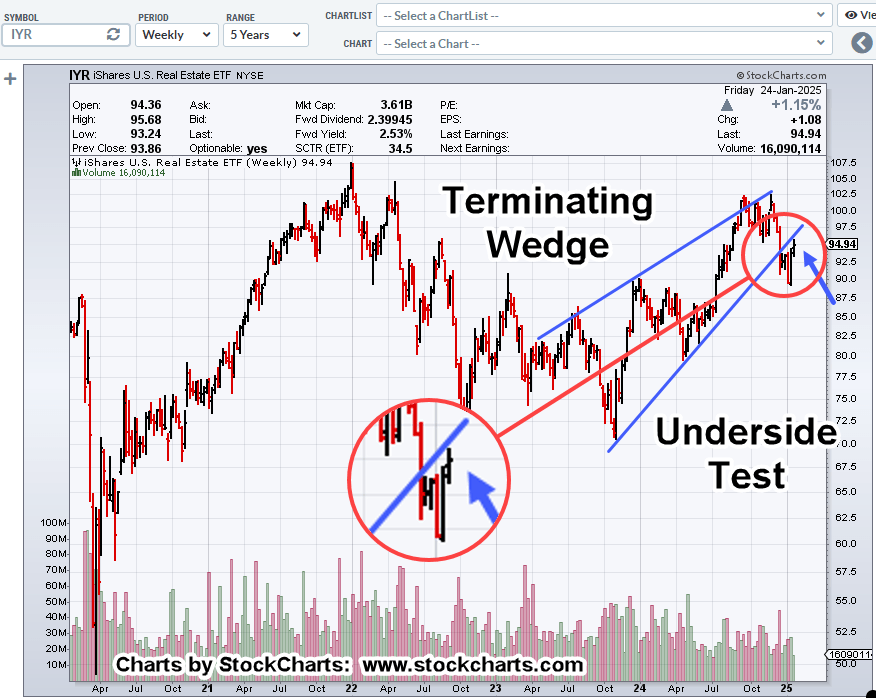
Next, we see there’s a terminating wedge developing as volume declines; the inference, is lack of significant commitment at these price levels.
We’ll get close-in on the wedge; last week printed a lower weekly low and closed lower for the week.
There’s no breakdown of the wedge … yet.
At this juncture, it’s up to the bulls to show they’re still in control.
Inflation vs. Scarcity
We have without a doubt, the effects of the event from the past three years gaining momentum. Whether or not those effects reach a peak this year, is unknown.
A lot of the mainstream and YouTuber’s alike talk about the upward move in gold as the result of ‘inflation’.
Here’s a little bit of insight you’ll not find anywhere else; how about gold rising because the above mentioned ‘effects‘ are causing production volumes to decline?
Maybe it’s because of scarcity (along with nearly everything else) that’s causing the increase in price.
Just to drive that idea home, the latest total gold production numbers, listed here.
Gold production for 2020 dropped -8.2%, from the year prior. Year 2021 was down -1%, from 2020.
From 2010 to 1019, gold production increased or was flat year over year … that is, until 2020.
Note: Posts on this site are for education purposes only. They provide one firm’s insight on the markets. Not investment advice. See additional disclaimer here.
If we use the S&P as the proxy, it hardly even lasted that long.
Going back to just four days ago, we had this (emphasis added):
“It’s well known, stocks tend to rise in the first weeks of January. Tax loss selling is over and there’s typically some type of ‘relief’.
Don’t count on it this time (not advice, not a recommendation).”
Market Meets Expectations
It was expected on the first trading day of the year, the market would continue its downtrend.
After this morning’s 15-minute blip, that’s exactly what’s happening.
We’ve already discussed real estate IYR, (here, here and here) as well as the Q’s (here).
Now, there appears to be another sign of impending price collapse … the oil sector; specifically, Oil & Gas Index XOP.
As is typical, we’ll begin the analysis with the longer time frame, the weekly.
Oil & Gas Sector XOP, Weekly
There’s no secret to the chart below other than Livermore’s admonition for going short; that is, he finds a market that ‘goes down and stays down’ (not advice, not a recommendation).
The prior two down-drafts were quickly retraced; one in mid-July last year and one in September.
Not so, this time.
If we go to the daily, we have an ominous look where a downtrend could be validated.
Oil & Gas Sector XOP, Daily
The right-side trend is drawn as a dashed line, revealing the attempted breakout on the last two sessions in December.
Attempted trend line and channel breakouts are normal market behavior.
It’s clear in the case above, price action has quickly got itself back into the trading channel.
Summary
Of course, oil prices are not supposed to go down, right?
At this juncture, look at all the conflict and potential supply disruptions that are possible.
However, the price of oil and the price of the exploration/production equities are two separate things.
The price of oil could skyrocket further, and yet, the equites still collapse. Bear markets are all about price, wealth, and credit destruction.
Typical short positioning trade vehicles for this sector are DRIP (-2X) and DUG (-2X), or to short the XOP directly (not advice, not a recommendation).
Note: Posts on this site are for education purposes only. They provide one firm’s insight on the markets. Not investment advice. See additional disclaimer here.