Tales of The SOXX Top

Charts by StockCharts

Note:  Posts on this site are for education purposes only.  They provide one firm’s insight on the markets.  Not investment advice.  See additional disclaimer here.

CarMax (Crash) Clues

Hits ‘Target’, Then Reversal

Sales down, earnings down, car prices down, demand collapsing and yet, KMX, goes higher.

Frist off, let’s address the ‘clown show’ that bandies about ‘crash’ this, and ‘crash’ that … ad infinitum.

After you’ve said crash fifteen, thirty times or more on your YouTube channel, nobody’s listening when it really happens.

How about we all (myself included) take a cue from the late Dr. Martin Zweig as seen here, (time stamp 6:40) where he’s reluctant to say ‘crash’ even when it’s on the eve of Black Monday 1987.

Now, back to our update.

CarMax … Strategy

So, let’s review the CarMax situation from a calm but focused perspective.

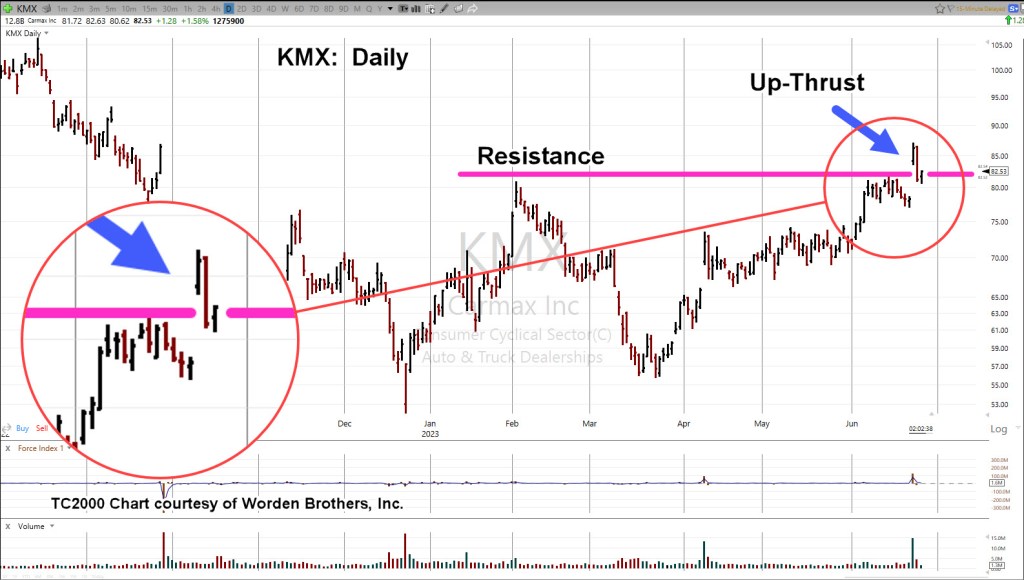
Strategically, KMX has met the price target identified last October (link here), and has apparently reversed.

The ‘Dead Cat’ Has Bounced

So, was last Friday’s earnings release high of 87.06, close enough to the ’85-area’ as forecasted?

As the magenta arrow shows, there could be small blip up to resistance in the 85-area before potentially rolling over into a descent that projects to the 4.00, level.”

It took over eight months to get back to the ’85-level’.

What happens next?

Fundamental Forces

It’s been the premise of this site, we’re at the beginning stages of the largest financial, social, and population collapse ever seen (not advice, not a recommendation).

From a CarMax perspective, we have this just out yesterday.

Car lots are overflowing and we’re playing musical chairs with inventory to make it look like something’s happening.

Next, we have a Ford employee writing in, to Jeremiah Babe, saying the Electrical Vehicle Plant is a “ghost town”.

What does that ‘clean energy’ ghost town mean for silver demand? Ah, but I digress. 🙂

We’re most likely just getting started. For a snapshot into what may come our way, take a look at this.

Now, on to the chart

CarMax (KMX) Quarterly Bar

The original chart from October 2022, is repeated below.

Now, the update.

CarMax, KMX, Daily Bar

When looking at the daily, we see we’re in Wyckoff Up-Thrust (reversal) condition.

We’re at The Danger Point®

Just so we’re not one-sided, here’s a bullish forecast for KMX (not advice, not a recommendation).

At this juncture, there’re no plans to go short (not advice, not a recommendation) … although it may not be a bad spot considering all the forces lining up.

An obvious stop level (for a short) would be last Friday’s high of KMX 87.06 (not advice, not a recommendation).

Stay Tuned

Charts by StockCharts

Note:  Posts on this site are for education purposes only.  They provide one firm’s insight on the markets.  Not investment advice.  See additional disclaimer here.

The Danger Point®, trade mark: No. 6,505,279

Key Reversal … Yet Again

Junior Miners Take Another Hit

With today’s outside-down (as of 2:43 p.m., EST), that makes it two key reversals for GDXJ, in the past five trading days.

While it looks like the whole herd is focused on the new mania, Artificial Intelligence, back at the ranch, the miners are painting an ominous picture.

Rendezvous With Destiny

The first two-minutes and ten seconds, at this link, are all that’s needed to get the idea of what’s likely to come.

The market recovered (fairly quickly) from 1987 … this time, may indeed be different.

The Elephant Sleeps

Ah, yes. The elephant no one talks about … or more accurately, are afraid to talk about.

Three links here, here and here, show us the elephant may be about to awake.

Even Fox News admits, it was all a lie.

Junior Miners GDXJ, Trend & Channel

From the bottom, May 25th to now, is a Fibonacci 13-Days.

Is that important?

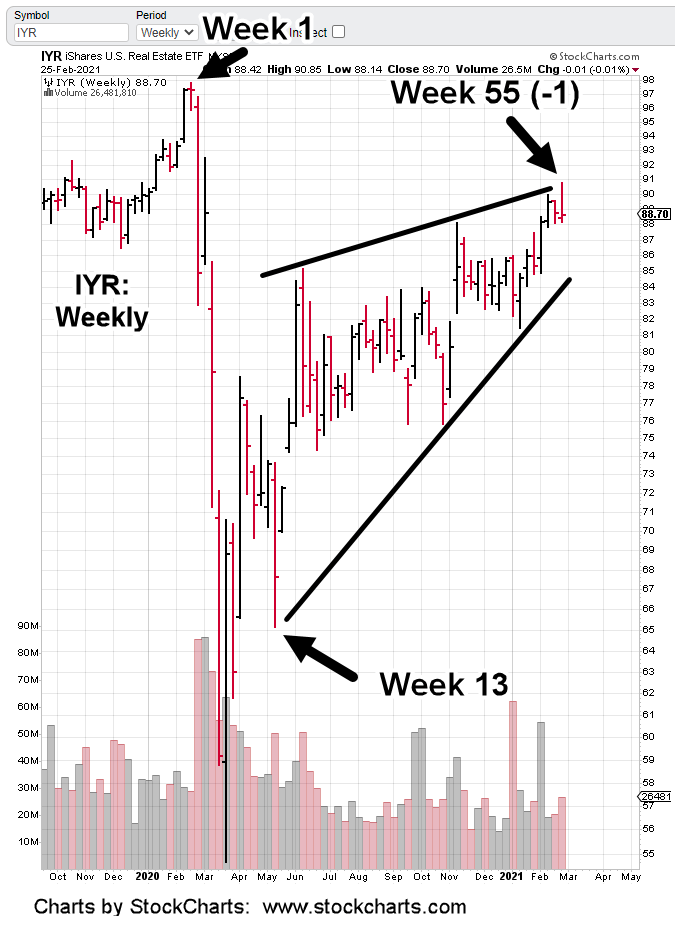
Here’s a prior analysis on Real Estate IYR, that shows how Fibonacci can identify the pivot point, trend and/or trading channel.

Now, back to the Juniors.

The mining sector appears to be under pressure. Each attempt to rally is being thwarted.

Compressed view of the channel, below.

The Fed announcement at 2:00 p.m., EST tomorrow, may or may not have any material effect. The sector may just continue lower …. slowly, without much fanfare (not advice, not a recommendation).

Stay Tuned

Charts by StockCharts

Note:  Posts on this site are for education purposes only.  They provide one firm’s insight on the markets.  Not investment advice.  See additional disclaimer here.

The Danger Point®, trade mark: No. 6,505,279

Oil Today … Gold Tomorrow

Commodities, Have Peaked

First, we’ll review oil; tomorrow, we’ll look at gold.

From an intuitive standpoint, you can almost feel it.

The oil and gas sector has launched to unsustainable highs.

Behemoths like Exxon (XOM) with its 63,000 employees have gone from below $30/share to above $110/share, an increase over 280%, in just two years.

In the history of the equity, going all the way back to 1984, that’s never happened.

Even in 1987, before the crash, XOM was up for the two-year period, a paltry 108%, by comparison.

Now, data is coming in nearly by the day about collapsing demand, layoffs accelerating, and inventories piling up.

The latest from Steven Van Metre, at time stamp 4:25, discusses just how fast the downdraft is, and will be.

Important Note:

Before we leave the Van Metre link above, at time stamp 8:50, the assertion is made of what the Fed will do when slower growth data comes in. i.e., interest rates will be halted or lowered.

Nassim Talib called this kind of thinking “Normalcy Bias”.

The opinion of this site is, it’s a trap. Thinking what happened last time, will happen this time.

Let’s mentally bookmark this post and come back six-months from now to see what happened.

We’re in uncharted territory and other agendas are at work.

Like ‘bread and circuses’, the ‘pivot’ discussion is a distraction … keeping the proletariat placated.

Demand Collapse

We’ve got demand collapsing on a daily basis right in front of our faces and yet, it’s a big mystery (to some).

What’s not known, is how the general population will react to undeniable truth when it finally hits, en masse.

We have a good hint of what’s in store as reported by Jerimiah Babe during the first minute of this report.

Moving on to the Oil & Gas Sector.

Oil & Gas XOP, Weekly

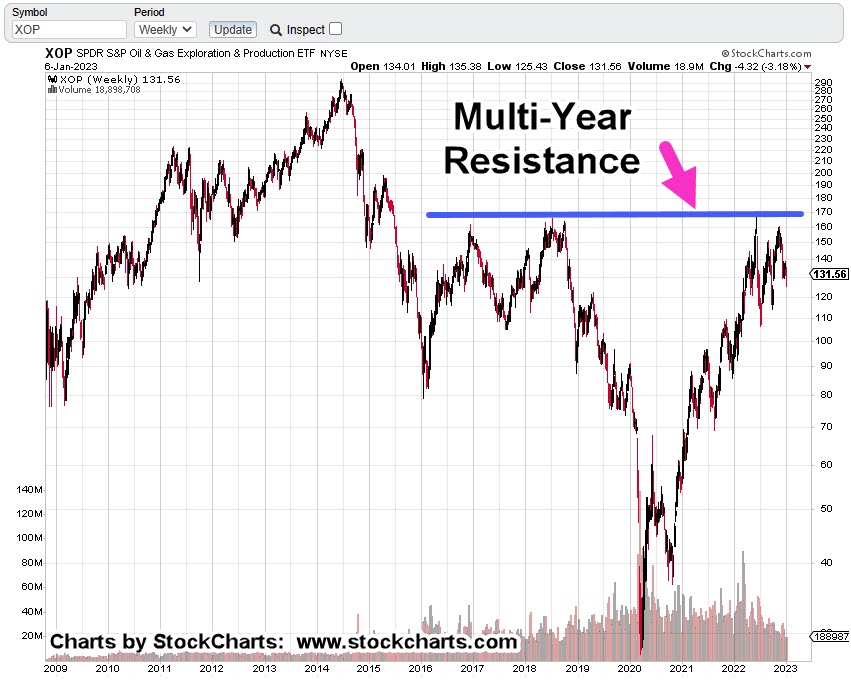
The weekly chart shows the multi-year resistance area that was tested (and rejected) back in mid-June, last year.

The next chart shows we also have a terminating wedge.

Price action has come back to the lower boundary; suggesting a breakdown is a probability.

If we get a breakdown, measured move support is identified at approximately -47%, below current levels.

Strategy & Trading

Obviously, the charts paint a bearish picture.

Over the past week, XOP was covered here and here.

The first link discussed how price action was very close to making a new daily high. That happened the next session (Friday) and indeed, it had Wyckoff ‘spring’ characteristics.

Price action moved higher and closed higher for the day, but it did not post a new weekly high … keeping the bearish case on the table.

A popular leveraged inverse fund is DRIP (not advice, not a recommendation).

At The Close

As this post comes to a close, a quick check on ZeroHedge turns up this: ‘Tipping Point

We’ve jumped over ‘recession’ and have gone straight into crisis and depression.

Stay Tuned

Charts by StockCharts

Note:  Posts on this site are for education purposes only.  They provide one firm’s insight on the markets.  Not investment advice.  See additional disclaimer here.

The Danger Point®, trade mark: No. 6,505,279

We’ve Seen This Movie, Before

1907, 1929, 1974, 1987, 2000, 2007, … and Now

As Scott Walters has said:

It’s different this time.

It’s Worse!

That ‘worse’ part includes the adverse moves in the market.

This time around, as opposed to ’07 – ’08, they really do seem to be worse.

Which, brings us to biotech SPBIO.

Biotech SPBIO, Weekly

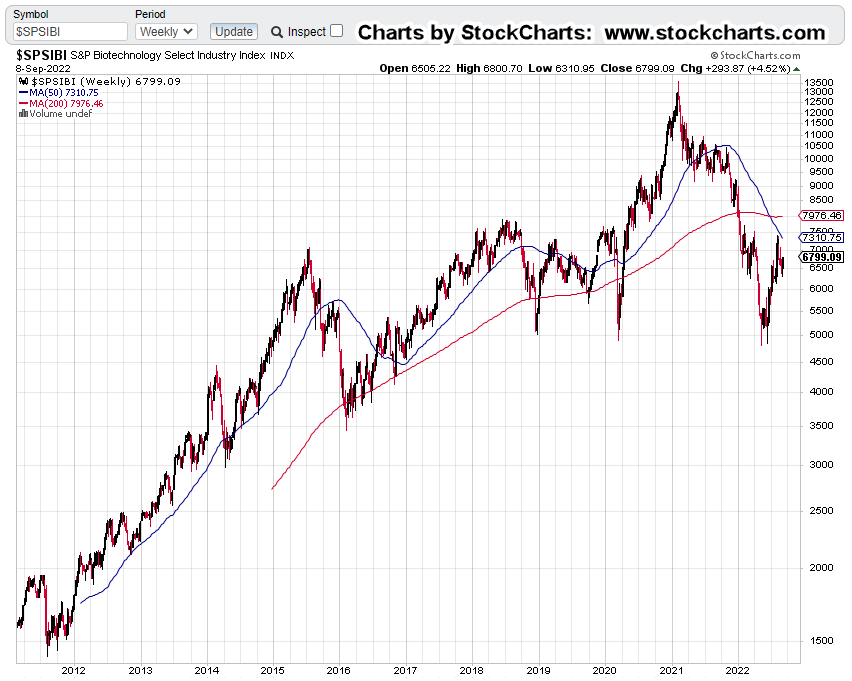
Just to remind ourselves where biotech is at the moment, we have the un-marked weekly chart.

This sector’s the only one (miners excluded) that’s trading below the 50-Week and 200 Week Moving Averages with a 50-wk cross to the downside.

On a weekly basis, we’re in a major long-term downtrend that looks to have finished its upside correction.

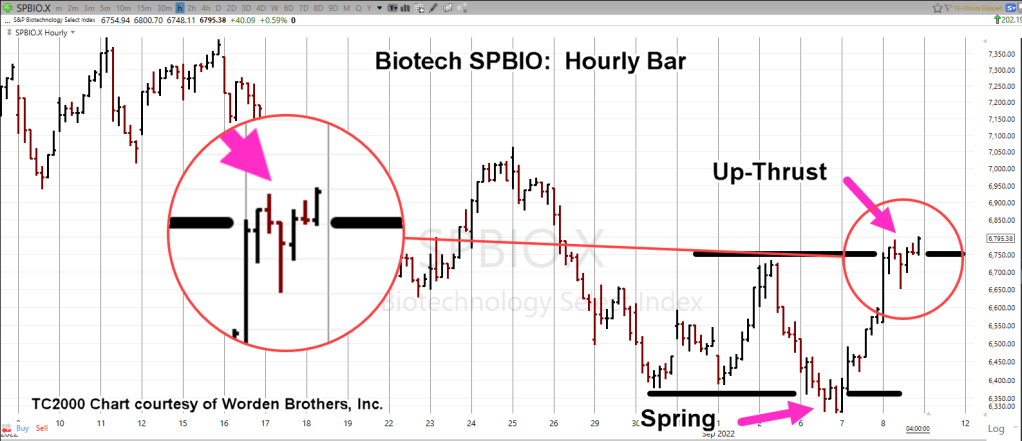
Getting closer-in on the hourly chart we have the following.

SPBIO, Hourly

What do you see?

Here’s the marked-up version.

Over and again; a fractal set-up called ‘Spring-to-Up-Thrust‘.

The zoom chart below shows that price action appears to be struggling at the resistance area (black line).

Danger Point

At this juncture we’re at The Danger Point®

Enough of a push higher and SPBIO, could continue on upward, overcoming significant technical and fundamental barriers.

However, since we’re trending lower in the longer timeframes, probabilities suggest that downtrend may be ready (or near ready) to re-assert itself.

Stay Tuned

Charts by StockCharts

Note:  Posts on this site are for education purposes only.  They provide one firm’s insight on the markets.  Not investment advice.  See additional disclaimer here.

The Danger Point®, trade mark: No. 6,505,279
SOXX, Downside Reversal

The Elliott Wave, Connection

A couple of things first.

Number One:

This site does not use Elliott Wave as a primary analysis tool.

However, to be aware of the technique, will at times provide an additional edge … like now.

Number Two:

Once again, gold and the mining sector have become unbearable to watch.

The amount of hysteria, hype and bloviation serves to make this market all about ego. Ego is a four-letter word for the professional speculator/trader.

We’re leaving it alone for now and moving on to the market at hand: Semiconductors (SOXX).

Semiconductors, SOXX

On a Monthly basis, the chart below is the entire trading history for the sector:

The next chart zooms into the area(s) of interest.

This market, the semis, had its most powerful thrust lower in January, for the entire history of the sector.

The following chart is where it gets interesting.

Elliott Wave labeling as shown. If correct, Wave 3, down has just started (not advice, not a recommendation).

Warning:

My former mentor, the late David Weis, who once worked for Prechter, said the approach is a “cookie cutter” (his words) attempt to force the markets into a pre-defined construct.

With that caveat in hand and the understanding the ‘wave’ could fall apart at any time, let’s see what it would project if price action followed the current labeling and structure.

The daily chart shows a Fibonacci projection based on the Elliott Wave labels:

The projections are in percentiles of the first wave distance.

Elliott Wave rules are that ‘Wave 3’ can’t be the shortest wave. If the structure holds, that means Wave 3 (if that’s what we’re in) would go below the 100%, level and potentially to 161.8%, level.

To Trade, or Not To Trade:

This structure was spotted late yesterday … after abandoning the gold sector. There had already been the pre-requisite hype about CPI numbers and such giving the ‘excuse’ for markets to rise.

That meant risk of a short position (yesterday, early today) was low: not advice not a recommendation.

The chart below of leveraged inverse fund SOXS, shows entry points for what is now: SOXS-22-01

Summary:

Taking a cue from the late Dr. Martin Zweig, on his words during this broadcast, he was very hesitant to use the word ‘crash’.

So, this update is hesitant as well.

However, if the forecasted move of SOXX, to the Fibonacci projected 161.8% level (or more) is realized, it’s a decline over – 37%, from current levels.

It would be significant … crash or not.

Stay Tuned

Note:  Posts on this site are for education purposes only.  They provide one firm’s insight on the markets.  Not investment advice.  See additional disclaimer here.

High Yield, The Canary

The canary in the coal mine could be High Yield, HYG

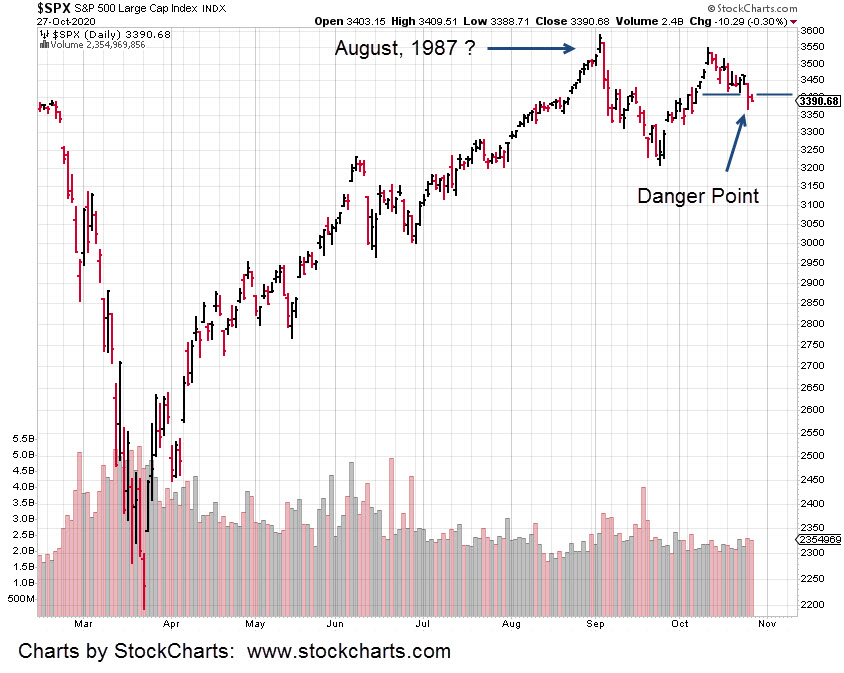
Since early last year, this site has been discussing growing parallels of the current market environment to that of August 1987.

Just recently, ZeroHedge began to pick up on the idea as well.

What’s becoming very obvious when looking at 1987, we’re in something much larger; possibly an order of magnitude (or two) larger.

Here’s the latest from Jeramiah Babe. Important time-stamps below:

2:15, Crypto (try it when the power goes out)

3:00, Inflation

3:30, Agricultural prices

3:40, Lumber prices

4:10, Middle Class destruction

5:00, Last longer than Great Depression

7:30, Dramatic shift (never to be the same)

10:00, “We’re in 2021 now. Anything is possible

A quick review of longer term momentum indicators on the major indices (or ETFs), below:

Technology based indices all have significant downside momentum.

The financial press may have pawned this off as ‘rotation’. Of course, that remains to be seen.

Our view, high yield tells us something much larger than a sector rotation’s occurring.

It’s possible, the most debt (interest rate) sensitive indices are reversing first which could be a sustained, long term reversal.

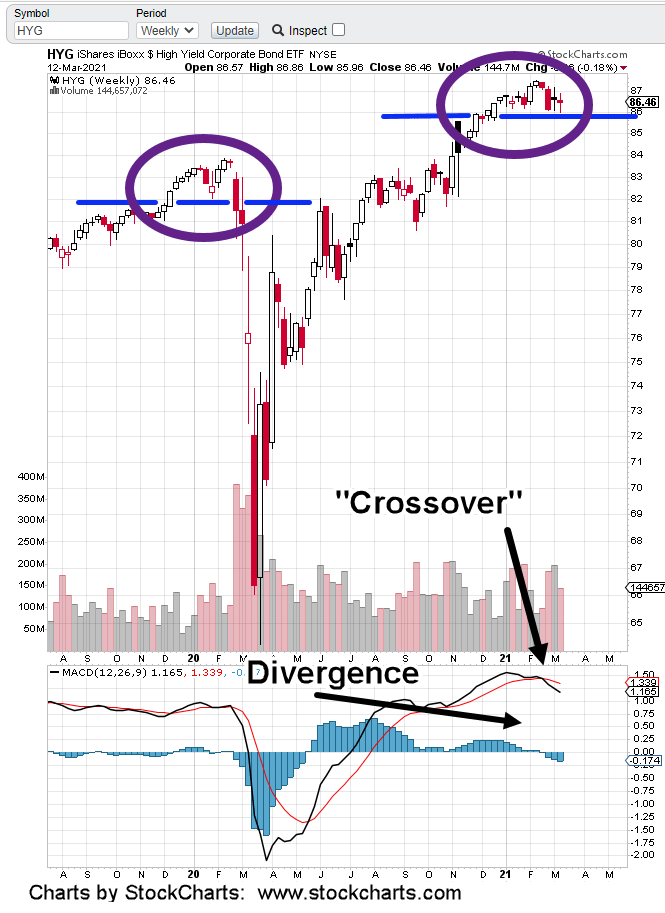
The HYG weekly chart pattern is similar to the prior reversal (magenta ovals). This time however, MACD has spent over nine-months in a divergence and has crossed to the downside.

There could be a new high … low probability but it could happen (after all, it’s at support). If it does, weekly MACD may post an even larger divergence.

In response to the HYG reversal, we’re watching (and are short) the biotech sector, IBB (not advice, not a recommendation)

Of the three noted above with negative momentum, IBB is the weakest. Last Friday’s action has tentatively confirmed the resistance areas and trading channel reviewed in this update.

Friday’s IBB lower action was nearly imperceptible but it was there. Major reversals can happen this way … a little at first.

Wyckoff said it in 1910, ‘It’s as if the weight of a feather can determine the next direction’.

We’ll see if there’s follow-through to the downside on Monday.

Stay Tuned

Charts by StockCharts

Note:  Posts on this site are for education purposes only.  They provide one firm’s insight on the markets.  Not investment advice.  See additional disclaimer here.

Real Estate … Implosion?

Watching J.B.’s (Jerimiah Babe’s) Los Angeles walkabouts, proves commercial real estate’s already imploded.

The instant the linked video starts, we see the root of the problem.

Neo-feudalism.

Of course, it’s all part of the plan but that’s a topic for another time.

What’s shown in J.B.’s video(s) is that one after another, commercial properties are boarded up and fenced off.

One might think it’s only progressive utopia California that’s having a rough time; taking a look at comments to his videos shows otherwise.

Just one example taken from the video link:

“Even if the U.S. lifted all lockdown restrictions 100% TODAY, I still think for many companies, its too late.”

The economy is not coming back … not in our lifetimes anyway.

No matter what happens, re-building will take many decades. Even so, the destruction has to be completed first.

We’re nowhere near downside end (economy, markets or otherwise).

On Thursday you would’ve thought from the news, we just collapsed by 50% or more. In fact, the S&P (SPY) was only down -2.41%.

Think about what happens we get the hit … that does not come back.

As early as May 12th of last year, this site began to note the similarities of the markets to August of 1987. In retrospect, that post (and the ones that followed) seemed a little premature.

It’s a different story now.

Markets even more extended; bond rates higher.

Throughout the years, going back to the early 1900’s, the professionals always preferred down markets. Profits (and fortunes) can be made much faster and with more reliability.

Fear is much easier to gage (on the charts) than greed.

With that in mind, we can look at real estate with a clear head and assess the opportunities.

It turns out, not only has IYR got itself into a terminating wedge, it’s doing so at Fibonacci time frames.

During the past six-weeks, my firm (link here) has been positioning in and out, and back in, several times using short fund DRV (not advice not a recommendation).

Just yesterday, before IYR broke decisively lower, that DRV position was increased to its maximum level thus far.

Obviously, a new high in IYR is not anticipated. The reason for selecting real estate as a strategic short (unlike the LABD swing trade) is for the downside potential.

Inverse leveraged funds work best during a sustained, directional move. It remains to be seen if DRV was a good selection; not only for a trade vehicle, but for the anticipated collapse in real estate.

Stay Tuned

Charts by StockCharts

Note:  Posts on this site are for education purposes only.  They provide one firm’s insight on the markets.  Not investment advice.  See additional disclaimer here.

Shades of 1987

Wasn’t it August of 1987 when the markets were stretched to extremes?

Then bonds headed lower … with rates going higher?

We know what happened after that.

Back then, the market peaked, retraced and then tried to make a new high which failed.

It was the failed move that set things into motion.

Then it was fast and volatile in the days leading up to Monday, October 19th. Markets do not repeat exactly but they do alternate.

So maybe it’s not August now, but February, March or April?

Getting back to October 1987. The late Dr. Martin Zweig discussed the possibility of a Monday crash during Louis Rukeyser’s Wall Street Week: Time Stamp 6:50 – 9:00.

While his assessment was important, perhaps more important was the rosy market forecast by the sell-side (retail) analyst (time stamp 8:37, link above).

That response to Zweig didn’t age well did it?

Three days later at the open, the market vaporized

Is truth more important than fairy tales? This site is about presenting objective analysis along with potential outcomes.

It’s likely we’re an order of magnitude greater than ’87. There’s no argument markets are stretched to obscene levels.

Now, we have interest rates rising sharply.

Will the result be the same? In the markets, anything can happen. However, if enough time has passed to forget (or be ignorant) about the past, it’s possible that it’s time to repeat.

Stay Tuned

Note:  Posts on this site are for education purposes only.  They provide one firm’s insight on the markets.  Not investment advice.  See additional disclaimer here.

October 1987, Is That You?

Price action has an eerie similarity to August 1987 and the months following.

To those old enough … recall how prices just seemed to press higher and higher during the summer months?  Stretched, they were.

Then came a break with a move lower.  After a while, a few weeks or so, it seemed as if the market was going to make another attempt.

The second attempt did not seem as energetic.  Prices continued on though … until they stalled and headed lower.

Just like now?

Continuing on with 1987, price action drifted on down; seemingly with out much fanfare until one day … a Friday there was a huge drop.

That was Friday, October 16, 1987.  We all know the action that followed on Monday.

Getting back to the markets at hand:

The last bond update showed a potential bullish set-up. 

There’s nothing that says bonds can’t start higher now.  In fact, it’s been two up days in a row for TLT.

If TLT penetrates the 160.98, level to the up-side, it’s a classical analysis (not a recommendation, not advice) buy signal on the weekly time-frame.

As of this post (7:01 p.m. EST), the S&P futures are already down -22 points, or about -.65%.  Correspondingly, bonds are higher.       

Charts by StockCharts

Note:  Posts on this site are for education purposes only.  They provide one firm’s insight on the markets.  Not investment advice.  See additional disclaimer here.