The last update contained the following statement:
“Such a shallow retrace is rare. More typical is at least a 38.2%, level being tested before price reverses and heads lower. “
Back in the days of my engineering work (see About), when making a statement or conclusion, other engineers (or science professionals) would immediately expect some kind of proof or supporting documentation.
It’s just the way their brains worked; it’s somewhat an implied (unspoken) requirement of the industry and a good thing as well.
A good engineering team (along with technicians) functioned more like a select military unit than a civilian office.
Very heady stuff; especially if you’re on a major project like aircraft flight test and certification.
So, after observing and working thirty-plus years of price action, the empirical observation of 38.2%, retrace being more common than 23.6%, had become my own mental note. Filed away with the other mental notes of price action.
That note’s easily supported … even on the fly as we’ll see below.
We have three charts of equities in the silver/gold mining sector that are currently all in a retrace.
Two of those went straight to 38.2%, while one of them hit 23.6%, first and then went on to 38.2%.
Agnico Eagle Mines (AEM) retraces to 38.2% and stalls.
Seabridge Gold (SA) retraces to 38.2% and stalls.
Wheaton Precious Metals (WPM) retraces first to 23.6%, and then moves on to 38.2% … and stalls.
Reading price action is partially an art-form and partially a science. The one thing that can’t (ever) be leap-frogged is experience.
Dr. Elder said it himself when he said ‘trading is an old man’s game’.
If you don’t have (but want) the experience, it’s best to get started now. Start racking up the hours … days … weeks and years.
Market Summary:
Steven Van Meter in this update (time stamp 1:39) shows the Rydex Bull/Bear ratio (courtesy of northmantrader.com). That indicator, along with what seems like everything else, is at a never before extreme.
Note: Posts on this site are for education purposes only. They provide one firm’s insight on the markets. Not investment advice. See additional disclaimer here.
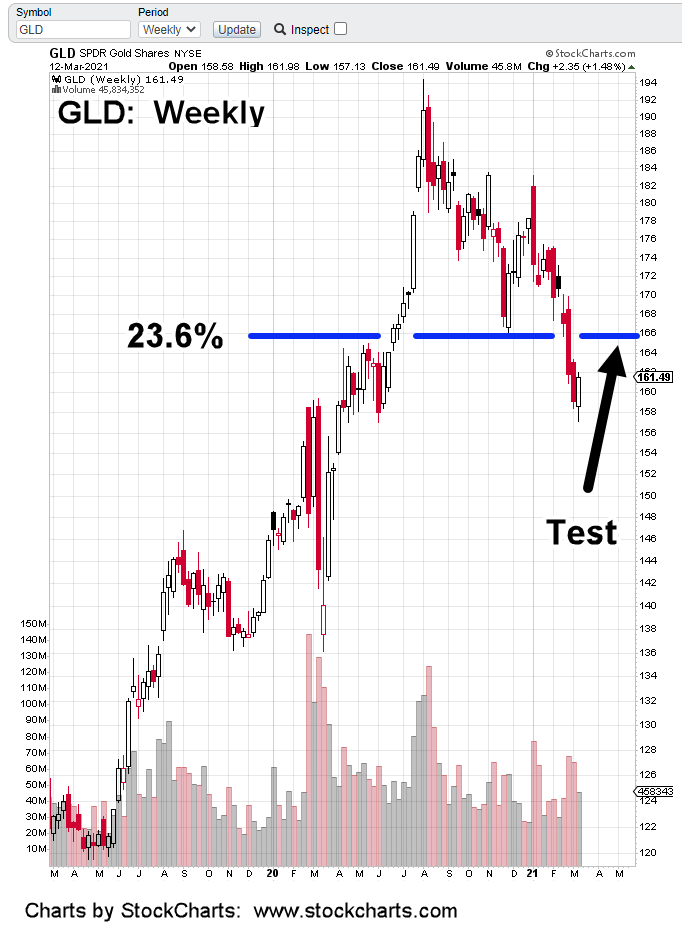
Last month, March 13th, had this forecast for GLD, to retrace at least to 166-area; a Fibonacci 23.6%, level.
So, here we are.
GLD closed last Friday, at 166.35 … close enough.
Before we get to the chart analysis, we have the following summary from the video link in the header line:
‘We were seeing some noticeable improvement in the economy … especially in the U.S. as the [speck protection] took hold.’
(time stamp 5:03).
‘Taking hold’, indeed.
We can see just how well that’s going, here, here and here … adding to a very long list.
Before we leave this topic, we have entire school districts being shut down from speck protection reactions.
Let’s extrapolate that into ‘entire grocery chains shut down’, or ‘entire air transport companies shut down’ and the picture is clear.
By now, anyone with two lipids rubbing together can see the false narrative has reached beyond absurd into a completely different realm.
We’ll just have to call it the ‘Twilight Zone‘ for lack of a better description.
All of this will affect the markets … gold included; probably in ways unknown at this point.
Analysis:
So, here we are at the 23.6% retrace. What’s next?
First off, 23.6% is very weak. It’s not typically seen as the final (upside) reversal point in general market behavior.
However, if GLD does reverse from here, posting new daily and weekly lows, it’s in serious trouble.
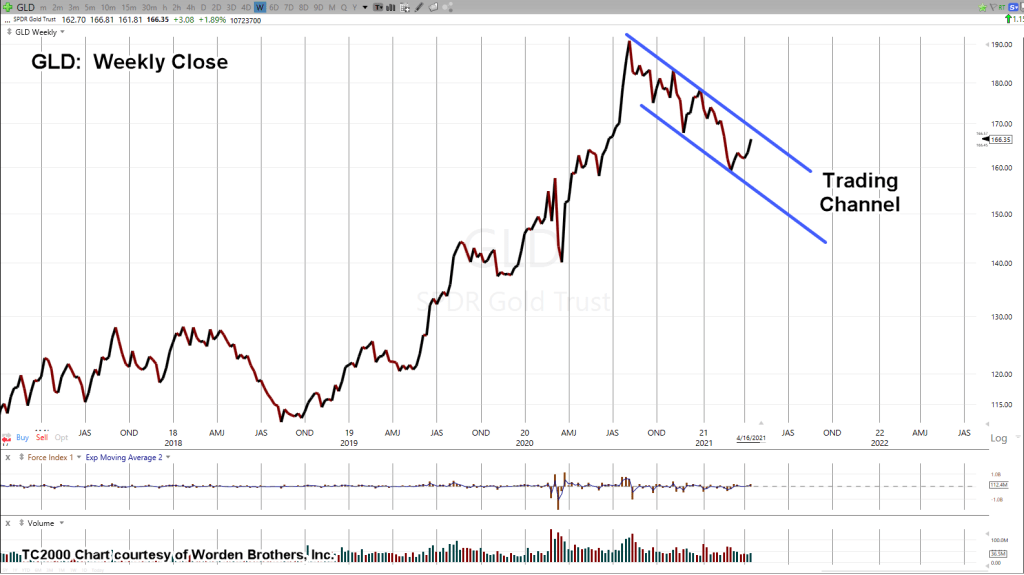
The next chart has GLD in a downward channel that’s been in-effect since last August.
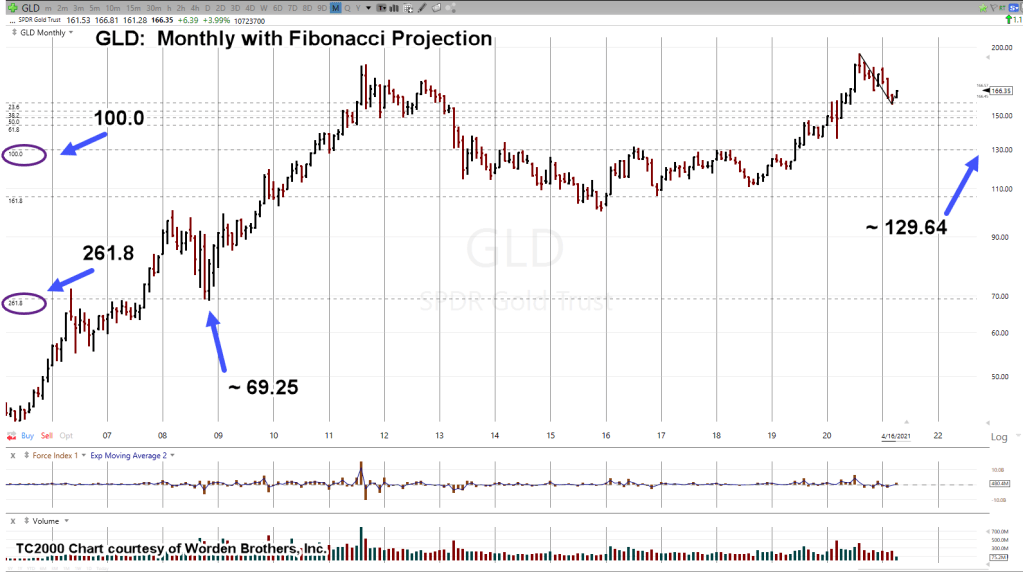
Pulling out to a longer time frame … the monthly; using a Fibonacci projection from these levels we have some interesting price targets.
Frist, is the 1:1, or 100.0% – 100.0% on the Fibonacci tool that projects GLD down to about 130 (129.64). This just happens to be the area Steven Van Metre has been discussing (as a potential target) for months.
Moving on lower to the 69.25 area for GLD, are targets mentioned by Harry Dent … albeit, years ago (actually, it was below $400).
We should keep in mind, a Fibonacci retrace of 76.4%, from all time high to cycle low, 1999/2001, is the 64-area on GLD.
Getting below $400 at this juncture seems unlikely.
Summary:
A downside reversal off 23.6% retrace would signify substantial weakness.
GLD would have to push below last week’s low of 161.81, to increase probabilities of a sustained downside move.
Stated many times on this site, precious metals are a crowded trade.
Operating at the same time, adverse reactions (and death) being caused by speck protection. A massive number of the population is subject to being permanently debilitated.
That could feed into the availability of all items; gold included but more importantly, the food supply.
To wit, CORN has just pivoted to the up side in a new trend; rising at over 437%, annualized.
More on that, later.
Stay Tuned
Note: Posts on this site are for education purposes only. They provide one firm’s insight on the markets. Not investment advice. See additional disclaimer here.
It’s about 9:37p.m. EST, on Sunday. Price action in the futures markets (SIK21) has silver up about +0.40%.
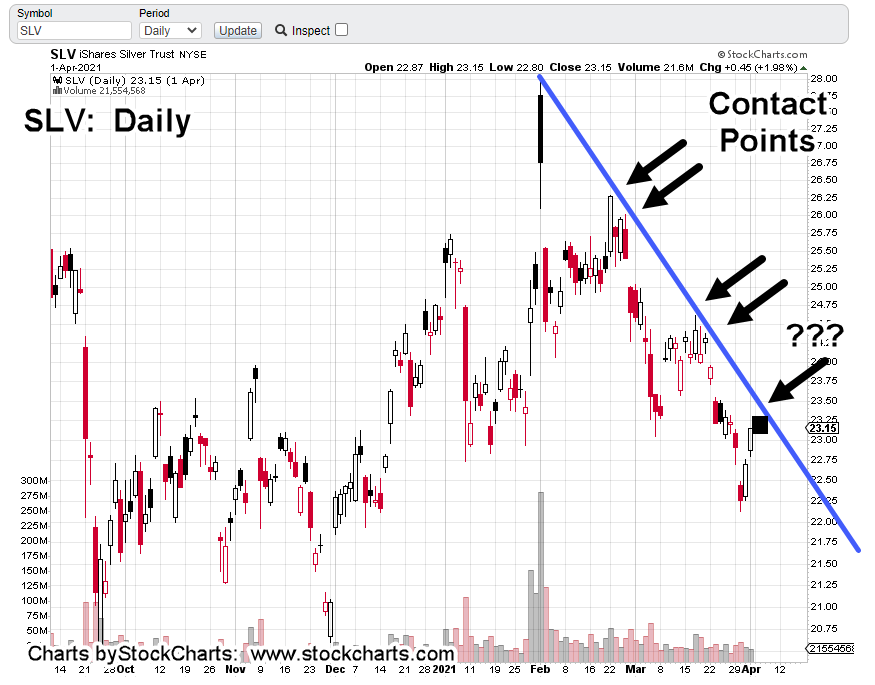
Projecting that action onto the regular daily session of silver, has it within the black box; located right up against the blue trend line.
At this juncture, the down-trend is still in effect.
In others markets … real estate:
A report just out by Uneducated Economist has ‘boots on the ground’ reports lumber inventory (for housing construction) is piling up at mills at levels never before seen … ‘stacked to the rafters’.
Note: Posts on this site are for education purposes only. They provide one firm’s insight on the markets. Not investment advice. See additional disclaimer here.
This is going to be one of those technical discussions that are tedious and long-winded (also to include at least one boring anecdote).
If desired, go to the Summary for the CliffsNotes wrap up.
For the rest, let’s get into it:
A quick look at the news and financial sites has the inflation narrative still raging.
This link to an article on ZeroHedge offers a slightly different perspective than one-way hyperinflation.
At least it says deflation is a possibility.
Back in the day, I used to read as many of these press releases as possible; combine them, put them in a spreadsheet, develop a ‘voting’ system (with variable adjusted algorithmic weighting), look at buy and sell recommendations, try to figure out if MACD, RSI and Stochastics could predict the next move … and then, I would watch Wall Street Week with Louis Rukeyser.
It’s a frustrating, unprofitable exercise that was ultimately abandoned while the search for market truth carried on; only to be found much later in 2007; that’s a story for another time.
There’s nothing wrong with Rukeyser. In fact, I did use his program (once) in what was at the time, a trade of pure intuition.
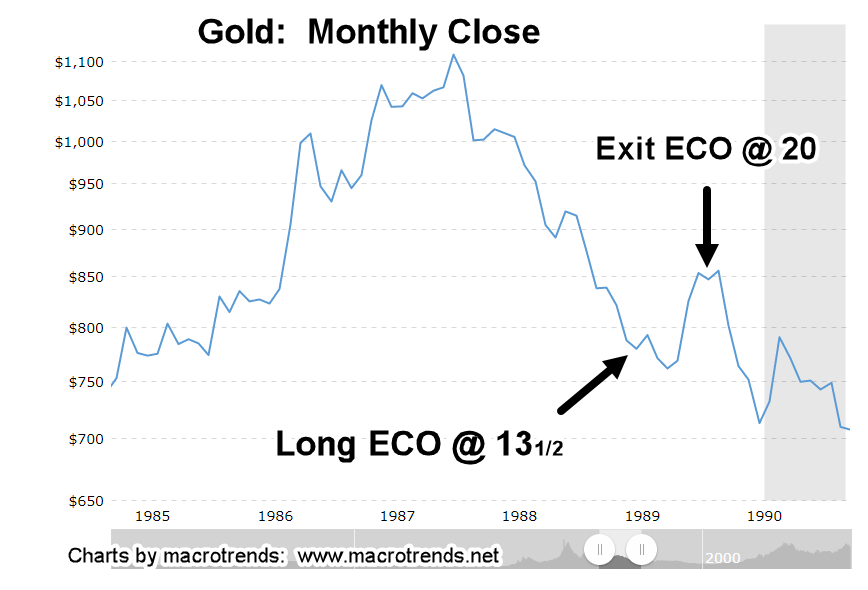
During his opening monologue (probably May 19th, 1989), Rukeyser talked about gold reaching multi-year lows.
The sense was ECO had slowed its decline and seemed ready to move higher. Gold also felt like it might retrace part of its decline.
The trade result is on the chart below:
The entry date for going long ECO was May 22, 1989, a Monday.
That would seem to follow if Rukeyser’s gold statements were on his (prior) Friday broadcast.
As the chart shows, gold bounced and then went slightly lower before going into a sharp (but short) rise.
The exit came on January 23rd 1990, right at the top of the brief move.
Once again, it was from intuitive feeling that gold had reached some kind of stopping point.
What solidified thinking ‘we’re at a top’, was Joe Granville coming out in his newsletter that he was going “all-in” on gold.
At the time, Granville was not making good market calls. This one seemed like a stab for attention as by now, gold was in the news.
To add to the nostalgia (looking at the confirmations), commission for going long (100 shares) was $47.60 and for getting out, $49.00
Many decades later and in retrospect, the trade worked because it was sentiment based.
After declining steadily for two years, gold sentiment was negative. At the top in January ’90, it had tuned positive.
What does all that have to do with today?
Looking at the chart of gold above, you’ll note a sharp rise in price from June of ’86 to October ’86. In effect, it’s a wide price bar.
From Wyckoff analysis, markets tend to come back to wide areas for a test. That’s exactly what we see from December ’87, onward.
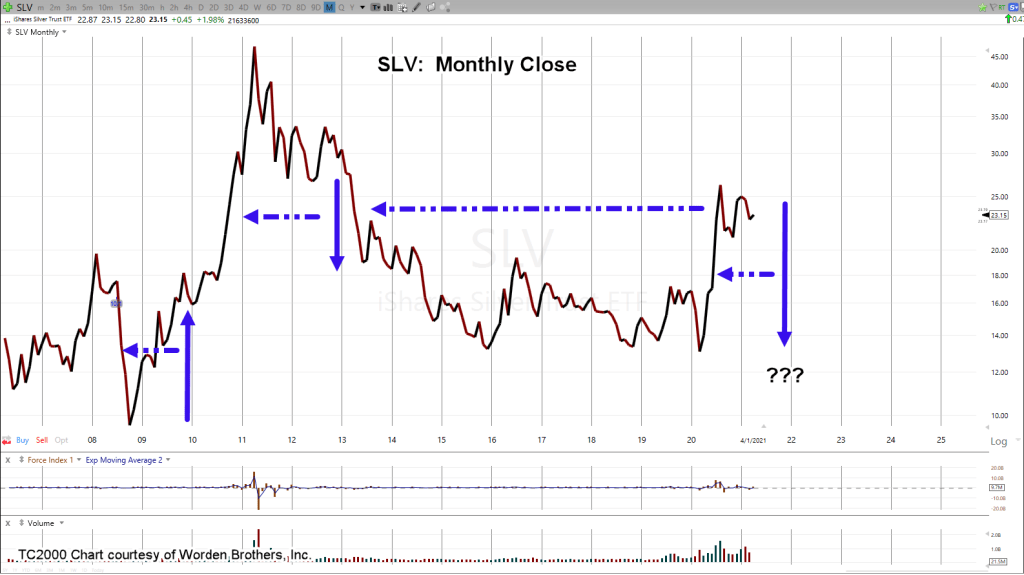
Now, let’s look at the monthly close of silver (SLV):
The chart shows how each wide bar has (ultimately) been tested. Price action either rises to test or declines … but it does test.
This is how markets behave. It’s what they do.
Looking at the current situation for silver, one would think it’s time to exit (if long); anticipating a retrace or go short (not advice, not a recommendation).
There’s a wide bar from the March 2020, low to the August 2020 high, that has not been tested.
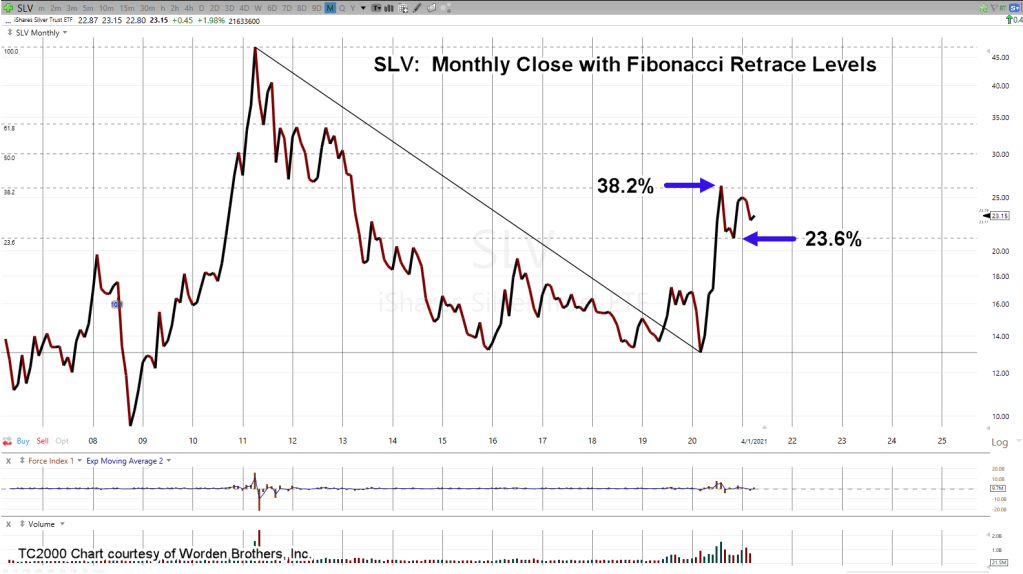
That (test) thinking is bolstered further, by the chart below:
On a monthly closing basis, SLV has pivoted (down) off the 38.2% Fibonacci retrace level when looking at the entire decline from April 2011, to march 2020.
In addition, it tagged the 23.6% level as a pivot to the upside which led into the now famous, but fading fast, ‘short-squeeze’.
It’s important to note, the short squeeze was so weak, it could not even register a new closing high on the monthly chart.
Summary:
It’s not important or profitable to figure out whether it’s inflation or deflation. The important part (and the hard part) is to read the price action itself.
That price action … at least for silver, is saying we’re at a juncture (Friday’s close) where SLV’s in position to retrace and test the wide trading area created from March – August, of last year.
A retrace is possible because that’s what markets do. Our anecdote example from 1989, shows that markets do not change.
If silver, SLV opens lower on Monday, it weights the probability we’re on our way to the 17.50 – 18.00 level and/or a test the March ’20 lows.
If it opens higher, the market’s in spring position (ready to head higher) as described in this link.
Note: Posts on this site are for education purposes only. They provide one firm’s insight on the markets. Not investment advice. See additional disclaimer here.
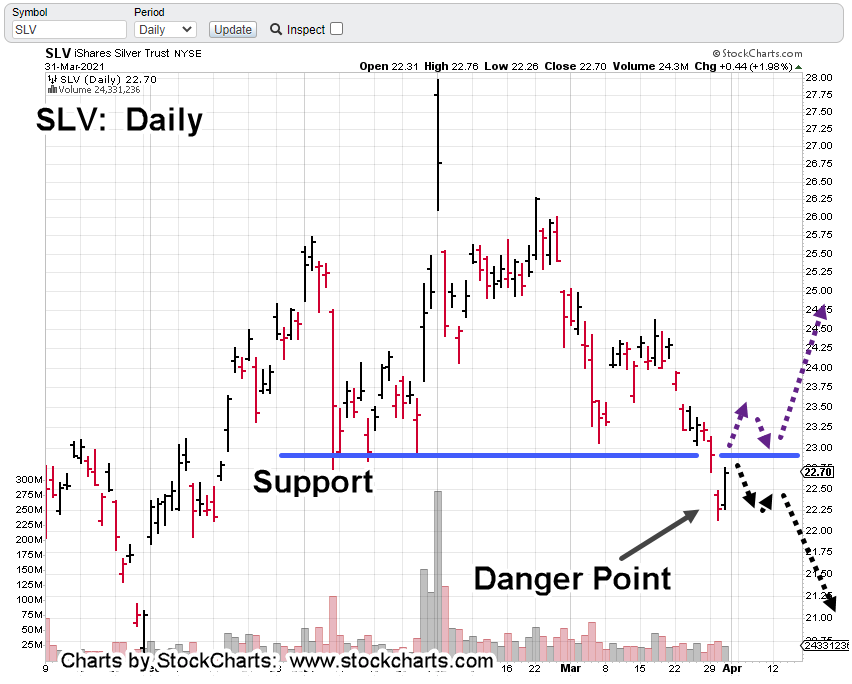
Silver, SLV’s at a juncture where it can either go sharply higher or continue lower from here
Punching through support puts SLV at the danger point.
Whenever price action penetrates support and hesitates, it’s in Wyckoff spring position; poised to move higher.
Because we’ve got a weekly MACD bearish divergence in addition to a huge volume ‘changing of hands’ on February 1st, probability would favor downside action … continuing on to 17.50 – 18.00 area.
Nonetheless, SLV could rally from here … even in the midst of a longer term bearish (deflationary) environment.
The precious metals sector is a crowded trade and one to be avoided (not advice, not a recommendation).
An interesting post on the current inflation/deflation scenario is here.
Note: Posts on this site are for education purposes only. They provide one firm’s insight on the markets. Not investment advice. See additional disclaimer here.
Bonds could be reversing but have already pushed rates high enough (long enough) to choke-off critical sectors of the economy like here and here.
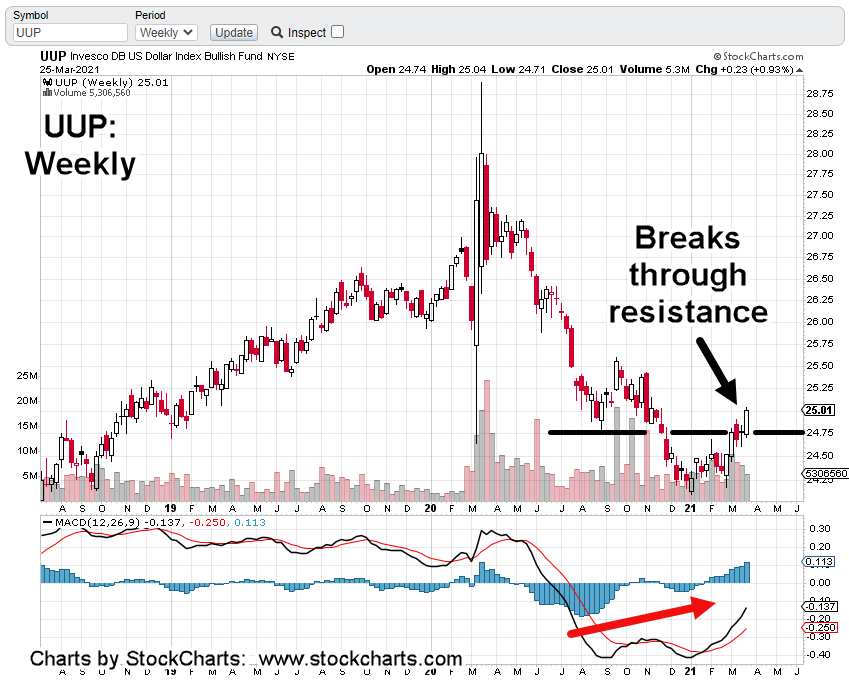
Now we see the dollar has bottomed as well.
It looks like a strong multi-month (or year?) rally. Correspondingly, gold is weak. The overall markets are stretched to ever-livin’ extremes; never before seen.
Whenever this baby pops, try logging on to chaos, or exit any position (except maybe for the long bond).
Our approach then (not advice, not a recommendation), is continue work on positioning short. So far, the ‘project’ is taking small hits in those attempts. We’ll see how basic materials (SMN) works out today.
Note: Posts on this site are for education purposes only. They provide one firm’s insight on the markets. Not investment advice. See additional disclaimer here.
Judging from comments on the financial sites, the public still thinks food prices are rising because of inflation.
There are exceptions (thankfully) like the comment area on ZeroHedge articles. Those few but growing number, understand exactly what’s happening.
So, what’s all of this got to do with the price of gold?
It’s perfectly natural and maybe expected that gold, GLD, after breaking support will rally back to test the 166 (~ $1,660) area.
Just like the incessant narrative on “The Speck“, which is drilled into the collective consciousness day after day (except maybe in South Dakota and Texas) so too, is the hyperinflation Weimar Republic narrative.
A Black Swan (as explained by Nassim Taleb) is a major unexpected event.
The flip side, a Black Swan is also a major expected event, that does not happen. That second definition is not commonly discussed.
What if hyperinflation never happens? What if there’s some kind of ‘transition’ before it has a chance to take hold?
If GLD tests 166, and reverses, downside targets are now 133 and then even lower at 110.
If that happens, there could be a market crash to go along with it.
With margin debt levels the highest in history, most if not all participants will be wiped out long before gold at $1,100 (or lower).
Silver and gold at fire sale levels and the public will be on the other side of the fence, turning in their precious metals hoard in exchange for worthless fiat dollars … just to survive.
Note: Posts on this site are for education purposes only. They provide one firm’s insight on the markets. Not investment advice. See additional disclaimer here.
With the kids at the card-table, freaking about ‘plunge protection team‘, rigged markets and Bitcoin, grownups the next table over, are planning their moves.
Friday’s late session rebound higher was not uncommon for a typical short squeeze.
These gyrations are intended to make sure only a select few are aboard when we get the break.
This idea is not new. You’ll find statements to that effect over and over in most any trading book.
The big difference now, is the amazing level of complacency and learned helplessness of the overall population.
Just one example of such before we move on to the charts.
Texas has opened up. Schools are about to go without diapers. Perish the thought.
Yet, there’s still a contingent that’s near hysteria about ‘safety’.
With all the information available, yes one actually has to do real research to find out what’s going on, huge segments of the population adamantly remain (intentionally) ignorant.
Unfortunately, that segment has voluntarily (at least in the U.S.) lined themselves up to be taken out; financially as well as physically.
Just a few of the most recent links, here, here, and here.
At some point, those links are going to become common knowledge.
Hopefully, there will be long lasting and certain retribution for the perpetrators. However, for those who ‘volunteered’, it’s already too late.
Now, on to the markets.
Friday’s real estate rebound (IYR) looked like short-squeeze action.
In response to that and late in the session, short position DRV (3X inverse IYR) was increased at price 9.37 (not advice, not a recommendation).
Volatility is still low in IYR. Short positions can be increased with less risk.
The Big Break
When and if the break comes, it’s likely to be fast; no time to plan.
Whatever plans one has should’ve been laid out well ahead of time.
Two markets being watching closely are Peabody Energy (BTU) and Seabridge Gold (SA).
By now everyone’s aware that a certain far east country is going about its business and building their infrastructure … as if nothing had ever happened. Funny that.
Conversely, the coal market has bottomed out and so has Peabody.
On top of that, the Texas Freeze laid bare the farce that is climate change, global warming and green energy.
Quietly, without fanfare, coal is seeing increased demand.
The blue arrow is a gap in trading that could be filled.
To do that, there might have to be a massive market collapse, pushing BTU back to that level … if only temporarily.
Huge volume in the past six months shows that somebody’s buying.
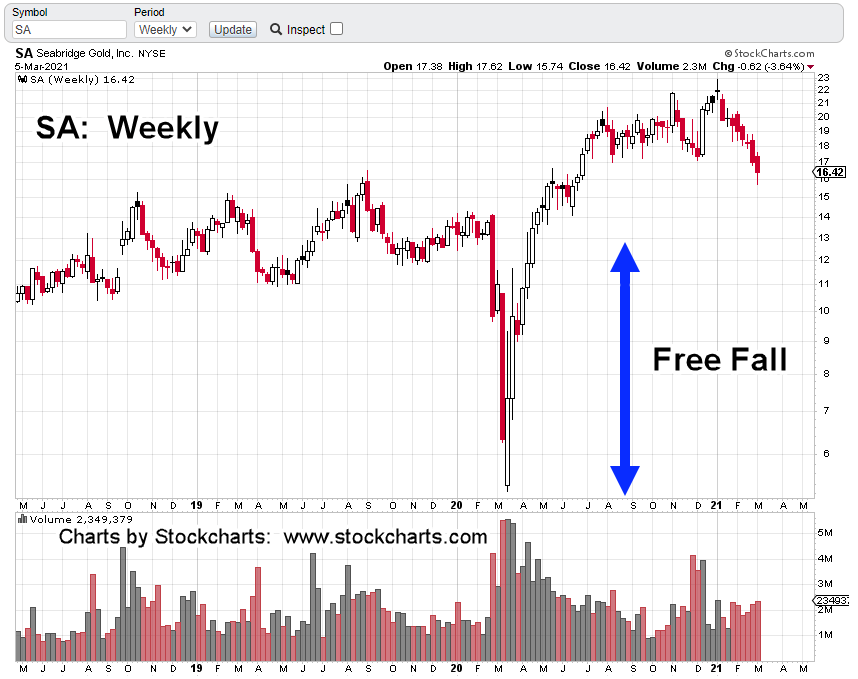
The next market is Seabridge Gold (SA) which is being watched for essentially the same reasons. If Van Metre is right and we’re in a deflationary impulse, the entire public’s on the wrong side of the trade.
If SA can get itself below 13 – 14, it then enters free-fall territory.
If that happens, as with BTU, it too might be a short lived event.
Positioning:
Currently, the firm’s position (not advice, not a recommendation) is short biotech and real estate via LABD and DRV, respectively.
If BTU and SA get to extreme lows, both of them have potential for a ‘ten-bagger’, the possibility to gain over 1,000%.
Getting to such gains would necessitate a change in the current strategy of trading, to buy and hold.
Summary:
Pressure seems to be building for some unexpected event that would cause a market break; Possibly the devaluation of the Yuan as discussed by Steven Van Metre.
Note: Posts on this site are for education purposes only. They provide one firm’s insight on the markets. Not investment advice. See additional disclaimer here.
In turn, that public has shown there’re certainly not going to educate themselves. If they were awake, news channel ratings (in the link) would be at zero.
Unfortunately, this time around, the game’s up.
The ongoing collapse will decimate those who refuse to wake up and will probably take some of those who are, with them.
What can be said? We can call it lies, misinformation, propaganda but none of those really get to the root.
Input prices are rising not from inflation, but from supply constriction and disruption.
For example, the corporate (big-Ag) food supply chain as reported on many times, is intentionally being destroyed. The result of course, prices go higher.
We’re also in a quiet sun-cycle period that only serves to help with (cold) weather extremes. The only discussion from the media concerning the weather is that’s it’s getting warmer, right? Opposite of reality.
So we’re taking that ‘opposite of reality’ as a contrary indicator.
Whatever inflation we’ve got after nearly twelve years, is probably at or near a peak … ready to head lower.
That includes the market as well. The likely outcome:
Market down, bonds up.
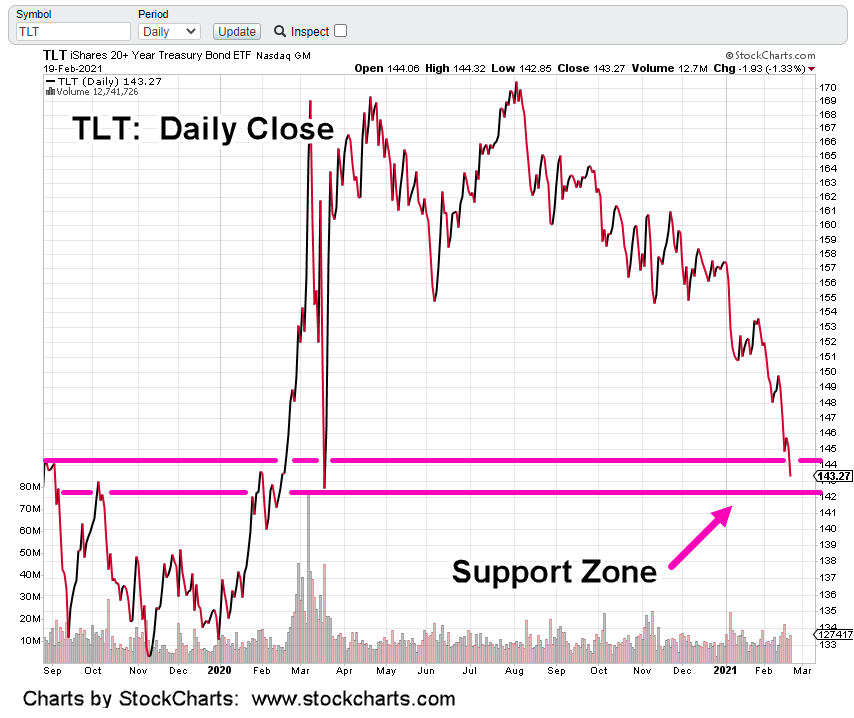
The daily close of long bond TLT, has it in a support zone. One attempt has already been made to position long via TMF (not advice, not a recommendation) as detailed in this report.
Once again this past Friday, another TMF entry.
Both bonds and the markets (i.e. S&P 500) are at opposite extremes. The risk of loss in bonds may have reached its nadir.
Note: Posts on this site are for education purposes only. They provide one firm’s insight on the markets. Not investment advice. See additional disclaimer here.
There are so many reasons why the silver squeeze is over; not the least of which is the constant bombardment of the supposed event in the financial press.
If the mainstream financial press is covering the topic (any topic) whatever the event, it’s over, irrelevant or an intentional miss-direction.
The little guy’s not going to put the big guys into a bind.
Potential action in SLV is above. We’ve got hits on the right side of the chart indicating a potential trend has formed.
There’s already precedent for a trend change with the massive volume spike on February 1st.
Inverse fund ZSL (not advice, not a recommendation) is showing the same trend potential but in the opposite direction … up.
As always, anything can happen. For example, an earthquake (seismic activity picking up world-wide) could wipe out production at some major mine and affect the price.
The chart above, shows the current potential. A trend may have been formed. If SLV price posts a new daily low (below 24.93), we have additional confirmation.
Note: Posts on this site are for education purposes only. They provide one firm’s insight on the markets. Not investment advice. See additional disclaimer here.










 The Danger Point®