Note: Posts on this site are for education purposes only. They provide one firm’s insight on the markets. Not investment advice. See additional disclaimer here.
A massive four-year top, along with the latest ‘road-map‘, has this one going down; most likely, for good.
While other chip makers, have gone to near stratospheric levels such as Nvidia, with its 23,960% gain from 2009, lows, Intel has languished.
The rest of the markets, S&P, Dow, QQQs, have pushed on higher while INTC, has spent the last four years, in a trading range.
A sideways market is a bear market.
Intel never recovered its luster after the Dot-Com mania of the 2000s. Price action spent eight years heading sideways-to-down before bottoming out in early 2009.
After that, it’s been a long struggle to current levels.
Now, the markets have reversed and the economy’s collapsing. We’ve likely seen market highs that won’t be repeated in the lifetimes of anyone reading.
Friday’s announcement may be the kick-off for sustained price action to the downside.
INTC, Chart Analysis
The daily chart shows at least one breakaway gap and possibly two.
The next chart is on the weekly timeframe and identifies the long, multi-year, topping pattern.
When looking at these patterns, be reminded about the scale of what’s happening.
This wedge is massive … at least four years in the making.
Note: Price action finished the day right at the lower support. There could be a rebound on Tuesday (market’s closed Monday) or we could just keep going lower.
The SOXX Connection
Intel’s fifth in market cap of the SOXX, with Taiwan Semiconductor (TSM) at the top of the list.
Even the leader TSM, may not be immune to trouble.
Here are Fab locations for Taiwan Semi, located just off the coast of mainland China … nothing bad going to happen there, right?
In the case of the ‘wave’ analysis, if it proves correct, we’re possibly in for a sustained ride lower.
The daily chart of SOXX, shows each analysis point where a reversal lower was projected.
It’s clear from the chart and documented links, both methods nailed it … to the day.
Elliott was earliest and caught the exact point of inflection.
Wyckoff caught the test of the up-thrust.
Here’s the important part:
Wyckoff is a practical, bread and butter method. It looks at what the market’s saying about itself … is price action showing pressure to the upside or down?
Elliott Wave looks at where the market could be or is going.
If we’re really in an Elliott Wave Three down, it’s likely to be a decline like no other.
There are other indicators not market related, giving us hints, a massive collapse is ahead.
A Decline of ‘Biblical’ Proportions
Warning:
The following contains scriptural references.
Those who are in ‘it’s all a myth and fairy tales’ crowd, feel free to scroll to the ‘Summary‘.
For the rest of us, the secular world calls it ‘systems collapse’. The spiritual world calls it ‘judgement’.
Stated many times on this site, ‘the church’ is corrupt. Here’s just the latest salvo proving that point.
Along with the corruption, we now have the strong delusions prophesied over 2,000 years ago.
In reference to a Stew Peters broadcast, linked here, on the numerous media lies, is this comment (emphasis added):
“The only people to blame for this Stew are the ones who put on the mask, who distanced, who took the shot, who harassed other people and who advocated for my freedoms being taken away. Without doing five minutes of research.”
It’s not too much of a stretch to say, those who voluntarily injected themselves were (or are) in a place of delusion.
“And for this cause God shall send them strong delusion, that they should believe a lie:”
However, the injections are no lie … but the reasons for those injections are false.
Can this (spiritual assessment) really connect with what’s happening in the markets? How does it relate to actual price action?
Obviously, it can’t and shouldn’t be said that any specific price movement has been prophesied.
However, we can use the scriptural references to point us to the probability of events; the big picture, the situation at hand, the signs of the times.
The probability that we’re at some kind of major inflection point of Biblical proportions, seems exceedingly high.
Summary
Both Elliott Wave and Wyckoff Analysis, support the probability of lower prices ahead for the SOXX.
Because Intel (INTC) has been a laggard in the sector for years, suggests it may be one of the downside leaders.
As if to confirm the assessment we’re past the pivot, that generational highs have been reached, we have this just out, on ZeroHedge.
At the very bottom of the article, is a quote.
No, they’re not quoting from the King James Bible of 1611; they’re quoting from Shakespeare’s Richard III, of 1594.
Note: Posts on this site are for education purposes only. They provide one firm’s insight on the markets. Not investment advice. See additional disclaimer here.
It’s been long enough; most have forgotten the ‘Flash Crash‘ of 2010.
That crash happened in May of that year.
May of this year, would make it 12-years and interestingly, a Fibonacci 144, months.
Normalcy Bias:
As Nissam Taleb said in his book, ‘The Black Swan’, every day is like every other day on the farm, for Mr. Turkey … that is, until Thanksgiving Day.
Let’s take a look at the historical chart of Semiconductor ETF SOXX, and see the effect of a Flash Crash.
Easy to spot … prices did recover by the end of the day.
What about the next time?
This report just out on ZeroHedge, shows liquidity is drying up in the bond market. Actually, liquidity has been drying up ever since Dodd-Frank of 2010.
All of this is working (to increase risk) in the background.
Let’s take a look at another unprecedented event … the downthrust and apparent recovery in the semiconductor index, SOXX.
SOXX, ETF, Daily Chart
First up, is the unmarked chart of the index.
Next, we’ll show the recovery higher is on diminishing volume.
There’s no real commitment to the higher prices …. they are just drifting upward.
We’ve already shown the Elliott Wave assessment of the current structure. Now, let’s look at it from a Wyckoff standpoint; Up-Thrust and Test.
Price action posted an Up-Thrust, declined and now has come back for an apparent test.
Confirmation Bias
At this juncture, both Elliott Wave and Wyckoff Analysis present a price action structure that’s set for downside reversal.
In a way, we’re at the danger point for both methods.
Summary
From a personal and corporate standpoint, going long in this market and all markets for that matter, was abandoned long ago (not advice, not a recommendation).
To borrow a phrase from Dan at i-Allegedly, he repeats over and over in his videos, ‘We’ve had warning, after warning’.
So, we have.
The SOXX, is telling us, it’s ready to resume action to the downside. After-hours, already has the index trading lower.
Note: Posts on this site are for education purposes only. They provide one firm’s insight on the markets. Not investment advice. See additional disclaimer here.
The Danger Point®, trade mark: No. 6,505,279

p.s. The insight of 2010 Flash Crash, anniversary of Fibonacci 144 months in May of this year, is exclusive to this site.
Even though technical conditions show we’re at least in a correction, if not outright reversal or collapse, record inflows for 2022, vs. 2021, present the herd-driven behavior of the public (and funds), to go long.
According to the link above, flows have been out of bonds and lesser performing equities, into equities that have gone down less.
In addition, you can see some of that flow (not addressed in the article) going into gold and the mining sector.
Stepping Back
Pulling away from charts and indicators for a moment, figuratively closing one’s eyes to get a ‘feel’ for what’s happening, it looks like the following:
We’re in a (potential) massive juggernaut reversal that’s been decades in the making; possibly having origins going all the way back to the ’87, crash, the ’95, bull market and then, repeated bubbles of 2000, ’07, and now.
At this point, it looks like the ‘average investor’ is doing the only thing they know how to do … that is, go long.
Those with at least some market knowledge, just got decisively whacked with their ‘put buying‘ strategy as the market has rallied strongly off the lows.
Pavlovian Panic
We’re witnessing the knee-jerk reactions of a public that’s been conditioned for decades, not to ‘think’, but only ‘do’.
Expect this type of behavior to go parabolic if the markets really do turn lower on a sustained, long-term basis.
Prechter has written extensively about crowds or the herd; especially in his text The Wave Principle of Human Social Behavior.
We can see this visceral behavior real-time, in other seemingly unrelated markets. Two examples below:
First, we had oil futures going negative for the first time in history; then we have LNG tanker rates going negative first time as well.
The model seems to be:
“Everybody wants it, and then, they don’t”.
The crowd runs to and fro, effectively leaderless.
With that said, one can make a case we’re just beginning, or already in an economic collapse; now being followed by the early stages of a market collapse.
Meanwhile, The Elephant Gets Bigger
Let’s not forget the massive elephant that’s just now getting so large, it can’t be ignored (time stamp 2:40).
Recall the example at this link … disparate crowds have a tendency to come to the same decision and modify behavior, all-at-once.
You have to wonder, when that crowd is going to simultaneously press the Sell, button.
Hit, In The SOXX
Unprecedented events are everywhere. That includes the massive, ‘never before seen‘, thrust lower in the SOXX.
The uptrend shown in the weekly chart of SOXX, has been decisively broken and with enormous volume.
The week ending Friday January 28th, saw 16.7-million shares traded … the most ever for the index (ETF).
More detail on trend break
Then, There’s Elliott Wave
Before the ‘Elliotticians’ get miffed by the previous (cookie cutter) comments, here’s this:
When this method works … it’s great.
It provides good projection areas and the useful ‘Fourth Wave of Lesser Degree’, targeting.
Note: A quick internet search for this Fourth Wave method (authored by Prechter) turns up nothing.
Logging onto ‘Club EWI‘, putting in ‘Fourth Wave’ has no items found.
One can try contacting Elliott Wave International, to request a copy of this targeting method. It may still be available (for a price).
The data used by this author to target the 4th wave retrace (shown below), is from a hard copy, dated, 1/8/2003. That information was excerpted from The Elliott Wave Theorist, July 9th, 2002.
First, the 2-Hour chart from Thursday’s update is repeated below with the ‘lesser degree’, added in magenta font:
Getting closer-in on the 4th-wave area below:
It’s subtle and difficult to spot. The price action congestion area is the ‘4th wave of lesser degree’.
Summary:
The previous update showed entry points for what is now SOXS-22-01 (not advice, not a recommendation).
Friday’s price action put this position well in the green; getting it to +24%, based on the close.
The table below are the ETFs being tracked along with the leveraged inverse fund tickers.
The percentage gain/loss, is for this past Friday’s action and shown for the inverse funds.
Obviously, the semiconductors were hit the hardest on Friday and so, SOXS, had the largest gain.
A good stop level for SOXS would naturally be Friday’s low (not advice not a recommendation). If we really are in an Elliott Wave 3, down … price action’s expected to continue its decline with haste.
Note: Posts on this site are for education purposes only. They provide one firm’s insight on the markets. Not investment advice. See additional disclaimer here.
This site does not use Elliott Wave as a primary analysis tool.
However, to be aware of the technique, will at times provide an additional edge … like now.
Number Two:
Once again, gold and the mining sector have become unbearable to watch.
The amount of hysteria, hype and bloviation serves to make this market all about ego. Ego is a four-letter word for the professional speculator/trader.
We’re leaving it alone for now and moving on to the market at hand: Semiconductors (SOXX).
Semiconductors, SOXX
On a Monthly basis, the chart below is the entire trading history for the sector:
The next chart zooms into the area(s) of interest.
This market, the semis, had its most powerful thrust lower in January, for the entire history of the sector.
The following chart is where it gets interesting.
Elliott Wave labeling as shown. If correct, Wave 3, down has just started (not advice, not a recommendation).
Warning:
My former mentor, the late David Weis, who once worked for Prechter, said the approach is a “cookie cutter” (his words) attempt to force the markets into a pre-defined construct.
With that caveat in hand and the understanding the ‘wave’ could fall apart at any time, let’s see what it would project if price action followed the current labeling and structure.
The daily chart shows a Fibonacci projection based on the Elliott Wave labels:
The projections are in percentiles of the first wave distance.
Elliott Wave rules are that ‘Wave 3’ can’t be the shortest wave. If the structure holds, that means Wave 3 (if that’s what we’re in) would go below the 100%, level and potentially to 161.8%, level.
To Trade, or Not To Trade:
This structure was spotted late yesterday … after abandoning the gold sector. There had already been the pre-requisite hype about CPI numbers and such giving the ‘excuse’ for markets to rise.
That meant risk of a short position (yesterday, early today) was low: not advice not a recommendation.
The chart below of leveraged inverse fund SOXS, shows entry points for what is now: SOXS-22-01
Summary:
Taking a cue from the late Dr. Martin Zweig, on his words during this broadcast, he was very hesitant to use the word ‘crash’.
So, this update is hesitant as well.
However, if the forecasted move of SOXX, to the Fibonacci projected 161.8% level (or more) is realized, it’s a decline over – 37%, from current levels.
It would be significant … crash or not.
Stay Tuned
Note: Posts on this site are for education purposes only. They provide one firm’s insight on the markets. Not investment advice. See additional disclaimer here.
The Russell 2000 (IWM as proxy) has been congesting sideways for about five months.
While the overall markets, S&P, Dow, SOXX, IYR and the QQQs, have been moving on to new highs … the Russell has stagnated.
Taking a cue from Steven Van Metre’s reports on ‘who goes first’ in a downturn, it’s the small caps.
At this juncture, it looks like the Russell’s ready.
The six month daily chart of IWM below, shows choppy action.
Pulling back somewhat and labeling the bearish wedge, puts it into perspective (second chart):
Pulling out and labeling the wedge:
One item of note (not shown) at the top of the wedge, where price action pivoted lower (August 6th), is a Fibonacci 62%, retrace level.
So, we have a bearish wedge retracing 62% … along with non-confirmation of the overall highs; S&P, Dow, SOXX, etc.
Major reversals take a long time to form. However, once they get underway, it’s like a juggernaut to the bottom.
Harkening back to the oil (USO) bear market of 2014, nearly all (if not all) the YouTuber’s at the time, completely missed the bearish set-up.
What they did instead, once the downdraft started, was pump out update after update about ‘catching the bottom and setting up for the new bull market in oil’.
It never happened.
Oil continued lower for a year and a half before getting into a sideways range.
The big money’s in the big move. Monitoring the Russell provides confirmation a significant reversal’s in the works (not advice, not a recommendation).
As with biotech (SPBIO), already in a bear market, the IWM could break lower while the overall markets continue to thin-out and even make new highs.
Recall, we’re getting close to an up-coming holiday: Labor Day
The 1929, high was on the Tuesday just after Labor Day weekend.
Note: Posts on this site are for education purposes only. They provide one firm’s insight on the markets. Not investment advice. See additional disclaimer here.
The last update on SOXX, noted one thing missing was a new daily low confirming the reversal. About 15-minutes after that post, SOXX printed a new daily low.
Now, we’re in an underside test of the breakdown.
The daily close chart (above) shows price action coming back to the underside. This is how the market squeezes out risk of a short position (not advice, not a recommendation).
Yesterday’s update had a link to ZeroHedge about how the market ‘has to’ move higher this week; the ‘selling’ is finished.
A healthy way to view this type of information is to be aware of the source.
If it’s a major retail brokerage or trading firm, their own (internal) market stance is likely to be completely opposite their financial press release.
Let’s see what happens next.
We’re not looking to short the SOXX but it’s still an educational exercise to monitor the sector.
Note: Posts on this site are for education purposes only. They provide one firm’s insight on the markets. Not investment advice. See additional disclaimer here.
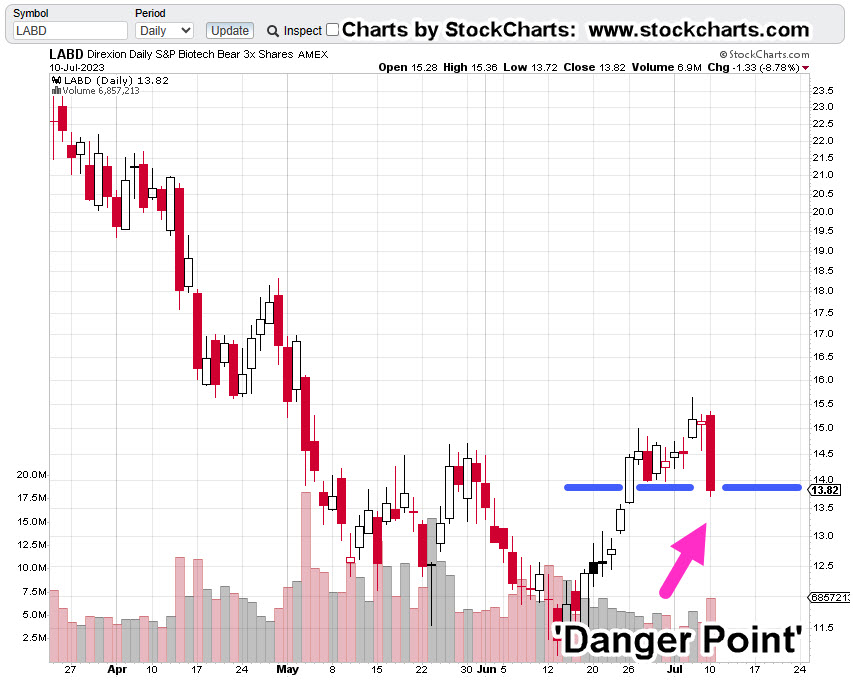
This morning’s gap lower in SPBIO (LABD higher) was fully expected.
Expected as well, is the retrace in progress as of this post.
Today, is Fibonacci Day 8 from the LABD, pivot low of June 28th.
Biotech (SPBIO) has posted a fantastic time sequence on the daily as well as the weekly.
The gap-lower open in the S&P (more so for SOXX) has everyone sharpening their pencils; wondering, if ‘this is it?’.
It could be.
However, with attention now focused on potential downside, the clean Fibonacci sequences are likely to morph into chaotic movement.
The time for low-risk short positioning (not advice, not a recommendation) in this sector may be coming to an end.
Looking at inverse LABD, and using the Fibonacci retrace tool, it’s likely price action will retrace to at least the 38%, level.
At this point, it’s already close:
The inverse biotech LABD, 15-minute chart (above) shows we’re near the 38%, level.
After today, the expectation is for price action to become SPBIO downside chaotic … long enough to frustrate the late-comers to the sector.
After that, and however long that is, price action may once again become orderly.
Stay Tuned
Note: Posts on this site are for education purposes only. They provide one firm’s insight on the markets. Not investment advice. See additional disclaimer here.
‘Spring-to-Up thrust’ is a common price action phenomenon.
Credit goes to the late David Weis for noting this behavior in one of his daily market updates from years past.
Now, we see it in action with SOXX.
As with airlines, semiconductors are highly susceptible to economic changes. Both operate on thin margins and have high capital costs.
Airlines (at least UAL and AA) have never recovered to new all-time highs. Maybe the semis went higher because of all the contract tracing that’s being projected.
However, noted in yesterday’s update, there’s a chance there won’t be much to ‘trace’; we’ll find out very soon.
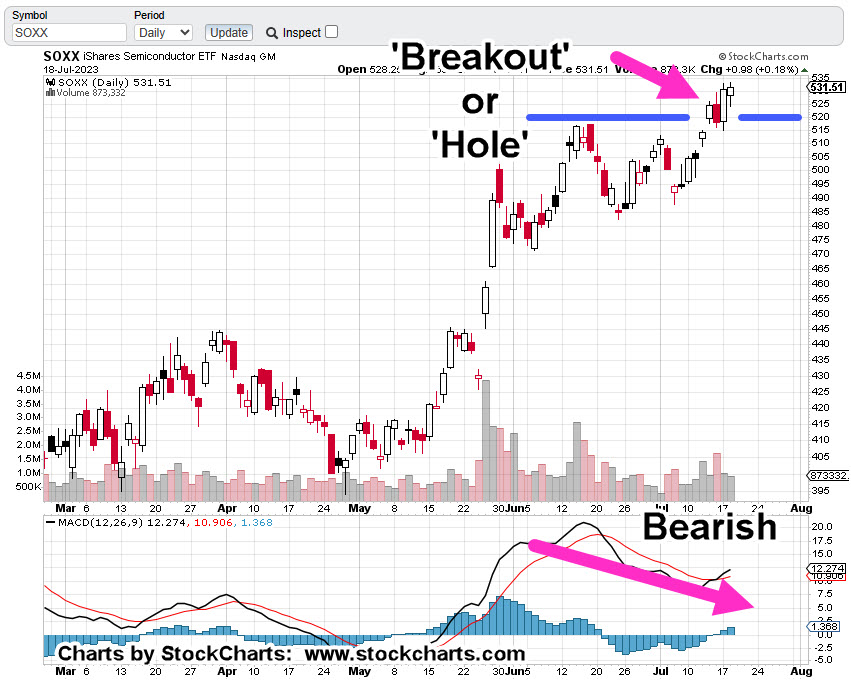
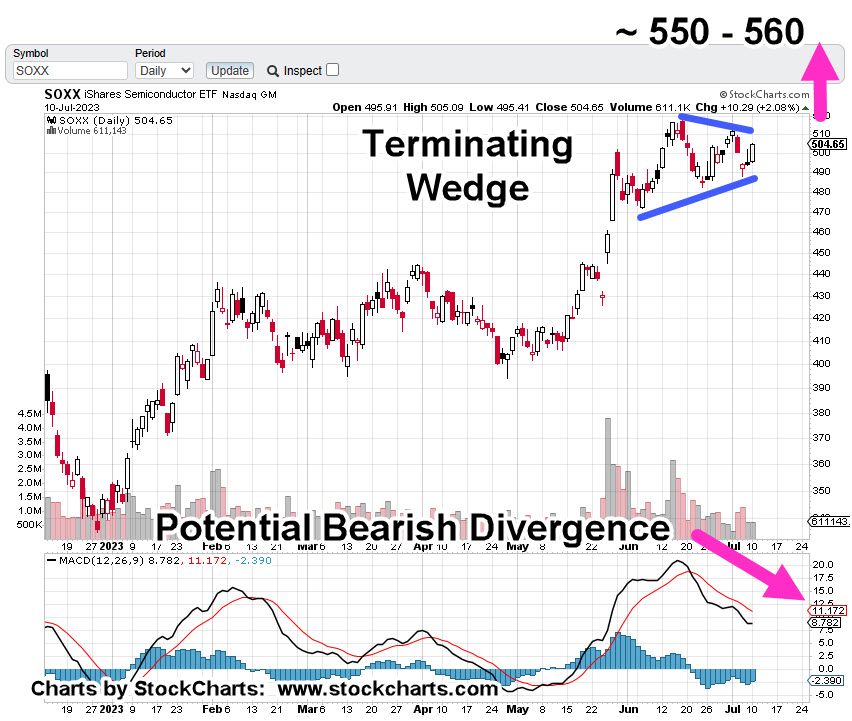
SOXX is at the danger point; risk of a short position (not advice not a recommendation) is at minimum.
As an extra reminder, we’ll add a frequently discussed theme for market tops: ‘Holiday Turns‘
Emperical data shows that markets tend to reverse before, during, or just after a holiday week.
Note: Posts on this site are for education purposes only. They provide one firm’s insight on the markets. Not investment advice. See additional disclaimer here.